

In the frozen expanse of the Arctic, a crisis unprecedented in modern transatlantic relations is unfolding. President Donald Trump’s renewed campaign to acquire Greenland has evolved from diplomatic overture to economic coercion, threatening to unravel decades of alliance-building between the United States and Europe. What began as an ambition Trump first floated during his initial presidency has escalated into what some historians now characterize as the lowest point in U.S.-European relations since the Suez Crisis of 1956.
The stakes extend far beyond Greenland’s icy shores. At the intersection of Arctic geopolitics, critical mineral resources, and the future of the NATO alliance, this confrontation reveals fundamental tensions about sovereignty, international law, and the rules-based order that has governed Western relations for three-quarters of a century.
Greenland occupies a geography that military planners dream about. The world’s largest island sits at the northern edge of the Arctic Circle, forming the western anchor of the Greenland-Iceland-United Kingdom Gap, a critical maritime chokepoint for monitoring Russian naval activities in the North Atlantic. Its position provides early warning capabilities for missile launches and controls access to Arctic shipping lanes that climate change is steadily opening.
The United States already maintains a significant military presence through Pituffik Space Base, formerly Thule Air Base, located 1,200 kilometers north of the Arctic Circle. Under a 1951 defense agreement with Denmark, American forces operate this installation and can establish additional defense areas deemed necessary by NATO. The agreement grants the U.S. broad operational latitude, leading one Danish scholar to observe that American de facto sovereignty over Greenland during the Cold War rendered Danish control largely fictional.
Yet Trump insists this arrangement is insufficient. Speaking aboard Air Force One, he declared that the U.S. needs Greenland for national security, describing the island as covered with Russian and Chinese vessels. Whether the minerals or the strategic location drives his ambition remains ambiguous – Trump has alternately emphasized both, sometimes contradicting himself within days.
Beneath Greenland’s ice sheet lies a geological treasure that has captured global attention. The island is estimated to hold approximately 36 million tonnes of rare earth elements, potentially the world’s second-largest reserves after China. These materials are essential for manufacturing high-performance magnets, electric vehicle batteries, wind turbines and military equipment – technologies at the heart of both the energy transition and modern defense systems.
Beyond rare earths, Greenland possesses substantial deposits of graphite, copper, uranium, zinc, gold and other critical minerals. In June 2025, the European Union designated the Amitsoq graphite project as a Strategic Project under its Critical Raw Materials Act, underscoring the territory’s importance to European supply chain resilience. China currently dominates rare earth production and processing, creating a strategic vulnerability that Western nations are desperate to address.
However, the path from geological potential to economic reality remains fraught with obstacles. Greenland’s harsh climate, minimal infrastructure and environmental regulations have stalled mining development. Local opposition rooted in concerns about ecological impacts and traditional livelihoods runs deep. In 2021, Greenland’s parliament reinstated a ban on uranium mining following sustained resistance, effectively halting rare earth development at the Kvanefjeld project where uranium is co-located with other minerals.
However, Greenland’s mineral wealth will take a decade or more to translate into meaningful supply, assuming projects can overcome both technical and social license challenges. The island has never produced petroleum, and previous attempts to mine iron ore ended in bankruptcy. Despite Trump’s rhetoric, experts emphasize that the U.S. could obtain these minerals through trade and investment without annexation – the approach used with other countries worldwide.
What distinguishes Trump’s second-term approach from his first is the willingness to employ economic warfare against allies. On Saturday, January 18, 2026, Trump announced that eight European countries would face escalating tariffs: Denmark, Norway, Sweden, France, Germany, the United Kingdom, the Netherlands and Finland. The measures would begin at 10 percent on February 1 and rise to 25 percent by June 1, remaining in place until the U.S. achieves what Trump termed the “Complete and total purchase of Greenland.”
The immediate trigger was Operation Arctic Endurance, a Danish-led military exercise in which small contingents of European troops deployed to Greenland. Trump characterized this routine NATO exercise as a dangerous provocation, claiming it created risks that were “not tenable or sustainable.” The tariff threat came on top of existing duties, potentially devastating European exports to the American market.
The announcement drew immediate condemnation. Eight targeted nations issued a joint statement warning that the threats “undermine transatlantic relations and risk a dangerous downward spiral.” UK Prime Minister Keir Starmer stated bluntly that applying tariffs on allies for pursuing collective NATO security was completely wrong. Even Trump’s populist allies in Europe voiced concern. Italian Prime Minister Giorgia Meloni, considered among Trump’s closest continental partners, called the tariffs a mistake, while French far-right leader Jordan Bardella described them as commercial blackmail.
The European Union convened emergency meetings, with all 27 member states gathering in Brussels. The bloc faces difficult choices about how to respond. France has pushed for activating the Anti-Coercion Instrument, a powerful trade weapon adopted in 2023 but never before deployed. This mechanism would allow the EU to restrict American access to the single market and limit trade licenses. Germany, typically more cautious, has expressed greater reluctance but indicated it would support deployment if necessary.
A middle-ground option under consideration involves implementing a €93 billion retaliatory tariff package targeting U.S. products from soybeans to Harley-Davidson motorcycles. This package was prepared last year during uncertainty over a U.S.-EU trade deal but was shelved when an agreement was reached. Trump’s Greenland threats have now derailed that deal, with the European Parliament suspending work on removing EU import duties on American goods.
Trump’s ambitions collide with multiple layers of legal and political reality. Greenland has been part of the Danish kingdom for eight centuries. While it achieved home rule in 1979 and enhanced self-government in 2009, the territory remains constitutionally integrated with Denmark, not a colony available for purchase.
Under Greenland’s Self-Government Act, the island is recognized as a self-determination unit capable of pursuing independence through a referendum among its 57,000 inhabitants. Such a decision would require negotiations with Denmark about terms, followed by approval from the Danish parliament. The process could take years, likely extending beyond Trump’s current term.
International law provides no mechanism for forced annexation. The U.S. explicitly recognized Danish sovereignty over Greenland in the 1951 defense agreement and reaffirmed that recognition in the 2004 amendment. Any military seizure would violate the UN Charter prohibition on the threat or use of force against the territorial integrity of another state. It would also effectively end NATO, as Denmark is a treaty ally protected by Article 5’s collective defense guarantee.
Danish Prime Minister Mette Frederiksen has been unequivocal in her response. In a televised statement, she declared that it makes absolutely no sense to speak of any necessity for the United States to take over Greenland, emphasizing that the U.S. has no legal basis to annex any of the three countries comprising the Kingdom of Denmark. Greenlandic Prime Minister Jens-Frederik Nielsen warned Trump to stop all pressure, hints and fantasies about annexation, calling the linking of Greenland to military intervention utterly unacceptable and disrespectful.
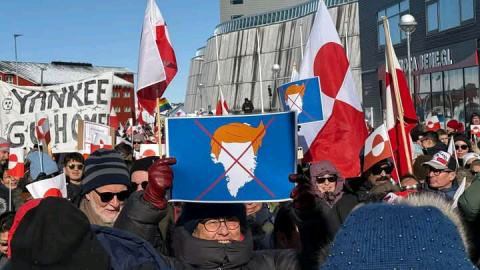
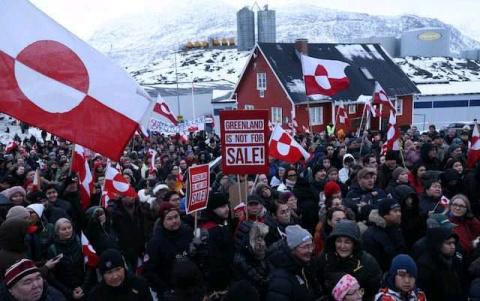
The people of Greenland themselves have spoken clearly. Polls indicate that 85 percent oppose American takeover. Many Greenlanders see their historical ties with Denmark as integral to their identity, even as some pursue eventual independence on their own terms. When Vice President JD Vance visited Greenland in March 2025, protesters gathered in Nuuk to reject American pressure. A demonstration on January 17, 2026, drew nearly one-third of the capital’s population.
The crisis has exposed fissures within the American political establishment. Several prominent Republican lawmakers have broken ranks with Trump over the Greenland issue, a rare occurrence given the former president’s dominance over the party.
Senator Mitch McConnell, one of the most senior Republicans, issued a statement calling threats and intimidation over Greenland unseemly and counterproductive. He warned that using force to annex the territory would constitute especially catastrophic strategic self-harm to America and its global influence. Senator Lisa Murkowski of Alaska argued that any effort to claim territory by force would degrade both national security and international relationships. Representative Don Bacon of Nebraska called the administration’s approach appalling, noting that treating a NATO ally in a demeaning fashion was unacceptable.
Even House Speaker Mike Johnson, while not directly criticizing Trump, expressed disagreement with proposals for military intervention. He stated that he doesn’t think military action is a possibility or that anybody is seriously considering it, though he did characterize Greenland annexation as in America’s interest.
Former Vice President Mike Pence warned that Trump’s current position threatens to fracture the strong relationship with Denmark and all NATO allies. Democratic opposition has been even more vocal, with Senator Ruben Gallego of Arizona leading efforts to introduce legislative restrictions on military action in Greenland.
The Greenland crisis has produced something rarely seen in European politics: rapid, unified action. Within hours of Trump’s tariff announcement, European leaders were coordinating responses through diplomatic channels and emergency meetings.
European Commission President Ursula von der Leyen emphasized that the EU stands in full solidarity with Denmark and Greenland, warning that tariffs would undermine transatlantic relations and risk a dangerous downward spiral. She stressed that Europe will remain united, coordinated, and committed to upholding its sovereignty.
Sweden’s Prime Minister Ulf Kristersson vowed that only Denmark and Greenland decide on issues concerning their territory, declaring that Nordic nations will not let themselves be blackmailed. France’s Foreign Ministry stated firmly that borders cannot be changed by force, with Finance Minister Roland Lescure asserting that Europe must be prepared to use its anti-coercion mechanism.
The response has transcended traditional political divisions. Anders Vistisen, a Danish member of the European Parliament from the right-wing Danish People’s Party, delivered a particularly blunt message during parliamentary proceedings. Speaking directly to Trump, he stated that Greenland has been part of the Danish kingdom for eight hundred years and is not for sale, concluding his remarks with an expletive-laden dismissal.
NATO Secretary General Mark Rutte has sought to play a mediating role, speaking with Trump about the issue while emphasizing the alliance’s importance. Danish Defense Minister Troels Lund Poulsen and Greenlandic Foreign Minister Vivian Motzfeldt traveled to NATO headquarters for previously scheduled meetings, using the opportunity to reinforce the message that any security concerns can be addressed within the alliance framework.
Trump’s rhetoric about Greenland intensified following the controversial U.S. military operation that resulted in the arrest of Venezuelan President Nicolás Maduro. The successful raid, conducted without American casualties, appears to have emboldened the president’s thinking about potential military options.
Following the Venezuela operation, Trump doubled down on Greenland threats, telling reporters that if Russia or China moves to take Greenland, the U.S. must act whether Greenlanders like it or not. He stated a preference for making a deal the easy way but warned of hard measures if necessary. White House spokesperson Karoline Leavitt confirmed that officials are actively discussing a potential purchase offer, while Secretary of State Marco Rubio told lawmakers that Trump would prefer to buy Greenland rather than invade it.
The comparison to Venezuela has particularly alarmed European observers. While military action against an authoritarian regime accused of human rights violations might be rationalized on humanitarian grounds, applying similar logic to a democratic ally and NATO member represents an entirely different calculus. Greenlandic Prime Minister Nielsen explicitly rejected the parallel, calling it so disrespectful that it demanded a response.
Some Trump administration officials have reportedly explored alternatives to outright annexation. Reuters reported discussions about a Compact of Free Association, similar to agreements the United States maintains with the Federated States of Micronesia, the Republic of the Marshall Islands, and the Republic of Palau. These arrangements grant the U.S. responsibility for defense and security in exchange for economic assistance, with precise details varying by agreement.
For a COFA with Greenland to work, the territory would need to separate from Denmark first, a process requiring Greenlandic self-determination followed by Danish parliamentary approval. Some Greenlandic politicians have indicated openness to such discussions as part of a broader independence trajectory. Parliament member Kuno Fencker suggested that while independence remains the goal, a COFA arrangement with both the United States and Denmark might be possible, noting that Greenland’s economy needs diversification.
However, this approach faces significant obstacles. The timeline would extend well beyond Trump’s presidency. Popular support for joining the United States remains minimal compared to support for eventual independence. And the economic arrangements would need to satisfy Greenlandic aspirations while addressing U.S. security concerns and preserving Denmark’s historical relationship with the territory.
Some analysts have attempted to quantify what acquisition might cost. If the U.S. government offered $100,000 to each of Greenland’s approximately 57,000 residents, the bill would total roughly $5.6 billion – a fraction of what the land itself might be valued at but a figure that captures the human dimension of the territory.
Yet financial calculations miss the deeper point. Greenland lacks the infrastructure necessary to support large-scale resource extraction or significantly expanded military operations. Roads connecting population centers are virtually nonexistent. Ports capable of handling major mineral shipments would need to be built. The housing and services required for an influx of foreign workers remain undeveloped.
Denmark announced a $6.5 billion Arctic defense package in 2025 in response to earlier U.S. criticism about inadequate protection of Greenland. These investments demonstrate Danish commitment to addressing security concerns through the existing NATO framework rather than transferring sovereignty.
Economists warn that the spring of 2026 will likely be dominated by thorny discussions over Greenland, similar to last year’s months-long wrangling before a trade deal was signed. Even if Trump postpones the February 1 tariff deadline to allow diplomatic measures to proceed, the underlying tension shows no sign of dissipating. One analyst characterized Greenland as a bonus play on Trump’s security agenda but noted that the president has demonstrated he genuinely wants the island, suggesting months or potentially quarters of uncertainty over tariffs.
The United States has pursued Greenland intermittently for more than 150 years. Following the purchase of Alaska from Russia in 1867, Secretary of State William Seward unsuccessfully sought to buy Greenland. The proposal resurfaced in 1910 and again in 1946, when the U.S. secretly offered to purchase the island from Denmark, only to be rebuffed.
During World War II, the United States invoked the Monroe Doctrine to occupy Greenland after Germany invaded Denmark, seeking to prevent Nazi use of the territory. American forces remained after the war, and by 1948, Denmark abandoned efforts to persuade them to leave. The 1951 defense agreement formalized this presence within a NATO framework.
In 1955, the Joint Chiefs of Staff proposed to President Dwight Eisenhower that the nation again try to purchase Greenland, arguing that sovereignty provides the firmest basis for assuring that territory and resources will be available when needed. The State Department responded that the time for such a plan had long passed because Greenland had become constitutionally and psychologically integral to Denmark. An attempt to acquire the island might endanger existing access, and unnecessary because the U.S. was already permitted to do almost anything it wanted under the 1951 agreement.
That assessment remained valid until Trump’s first presidency, when he characterized the potential acquisition as essentially a large real estate deal. Impressed by the island’s size – about 80 to 85 percent covered by ice – Trump declared it should be part of the United States. His advisers Tom Dans and others worked on the proposal until the last day of the first Trump administration, waiting for an opportunity to revive it.
Trump’s justification for acquiring Greenland centers on countering Chinese and Russian influence in the Arctic. His administration’s concerns are not entirely without foundation. China launched its Arctic policy in 2018, controversially referring to itself as a “Near-Arctic State” despite being located thousands of kilometers south of the region. Beijing has attempted to grow its Arctic footprint through scientific research expeditions, infrastructure investments and natural resource acquisitions.
Chinese interest in Greenland’s mining sector remains active. The Kvanefjeld rare earth project was majority-owned by an Australian company but had China’s Shenghe Resources as its largest shareholder and strategic partner, raising concerns in Washington about potential Chinese encroachment. U.S. officials reportedly successfully lobbied the Tanbreez mine CEO to sell to American bidders for less than Chinese-linked competitors, demonstrating the geopolitical competition playing out in Greenland’s resource sector.
Russia maintains a formidable Arctic presence with approximately seven to eight nuclear-powered icebreakers in service, including several new Project 22220 vessels, with more under construction to expand Arctic dominance. By comparison, the U.S. Coast Guard operates just three polar icebreakers. Russian activities in the region declare the Arctic a zone of Russian national interests and indicate opposition to changes in the status quo.
However, critics argue that these threats can be addressed through enhanced cooperation within existing frameworks rather than territorial annexation. Denmark and its NATO allies have proven willing to increase their Arctic military presence and share intelligence about Russian and Chinese activities. The 1951 defense agreement provides mechanisms for expanding U.S. installations if genuine security needs arise.
As European leaders prepare for an extraordinary summit to coordinate their response, the fundamental questions remain unresolved. Can diplomatic engagement defuse a crisis rooted in Trump’s apparent personal conviction that Greenland must become American? Will economic pressure through tariffs force concessions, or will it harden European resolve? And what happens to the transatlantic alliance if this confrontation continues to escalate?
Ireland’s Tánaiste Simon Harris captured the mood of many European officials when he told fellow finance ministers that the continent faces an existential moment in how it responds. The choice is between accommodating American pressure in hopes of preventing escalation or drawing a firm line to defend principles of sovereignty and international law.
For Greenland itself, the crisis represents both danger and opportunity. The territory has long sought greater economic development to support eventual independence. Increased global attention has brought potential investment and highlighted the value of Greenlandic mineral resources. Yet the aggressive American approach risks making any partnership politically toxic, particularly given local resistance to foreign interference.
Some Greenlandic leaders have attempted to navigate between competing pressures. While firmly rejecting Trump’s threatening rhetoric and any suggestion of forced annexation, they have left open possibilities for enhanced economic cooperation and dialogue about future relationships. The key word emphasized repeatedly is respect – for Greenlandic self-determination, for international law and for the democratic processes that should govern any change in status.
Danish authorities have sought to balance firmness with pragmatism. Prime Minister Frederiksen has delivered increasingly forceful rejections of annexation talk while emphasizing Denmark’s commitment to addressing legitimate security concerns through NATO channels. The government has accelerated Arctic defense investments and welcomed allied military exercises, demonstrating that cooperation need not require sovereignty transfer.
For the United States, the Greenland crisis poses profound questions about how it relates to democratic allies in an era of intensifying great-power competition. Former Ambassador Michael McFaul argued that threatening to destroy the NATO alliance for what he termed a vanity project in Greenland is irrational and dangerous. In the global competition with China that will likely last decades, he warned, alienating democratic Europe represents strategic malpractice.
The Greenland dispute transcends a territorial disagreement between the United States and Denmark. At stake is the future of the rules-based international order, the credibility of collective defense commitments, and the question of whether might makes right in the 21st century.
Trump’s willingness to employ economic coercion against democratic allies to pursue territorial expansion has shocked even seasoned diplomats accustomed to his unconventional approaches. The precedent it sets – that American security interests can override sovereignty, treaties and international law – has implications far beyond the Arctic. If the United States can threaten allies with tariffs and hint at military force to acquire Greenland, what message does that send to Russia regarding Ukraine, or to China regarding Taiwan?
European unity in response to the crisis demonstrates that limits exist to how much pressure the continent will accept. Whether that unity can be maintained through sustained American coercion remains to be seen. Economic pain from tariffs will test resolve, particularly for countries heavily dependent on U.S. trade. The temptation to seek bilateral accommodations rather than maintain collective resistance may grow as costs mount.
Yet the alternative – acquiescing to demands that violate fundamental principles – carries its own costs. As one European official observed, if we give in to Trump on Greenland, what will be the next thing? The precedent matters as much as the specific outcome.
For now, the world watches as this unprecedented crisis unfolds, with profound implications for how power, law, and alliance commitments interact in the modern international system. The resolution – whether through diplomatic compromise, economic warfare or some combination – will shape transatlantic relations and global order for years to come.
In Greenland itself, the people caught in the middle of great-power competition continue their daily lives on an island that has survived countless geopolitical storms. Greenland doesn’t want to be sold. Greenland belongs to Greenlanders, not to any outside power – a simple assertion of human dignity and self-determination that resonates far beyond Arctic shores.
By John Renton
© Preems