
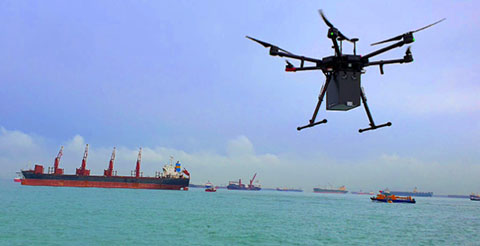
Ukrainian drone exports to the United States mark a historic reversal: battle-tested systems forged in the war against Russia are now flowing westward to equip the U.S. military, while Ukrainian firms establish production on American soil.
For most of the Russian full-scale invasion to Ukraine that began in 2022, Kyiv tightly restricted exports of finished combat drones. Domestic demand was absolute; production capacity, though rapidly expanding, was prioritized for the front. That barrier began cracking in 2026. In early July, Ukraine’s State Service for Export Control issued the first permit for complete combat unmanned systems – F-Drones Company’s F10 first-person-view (FPV) strike drones – destined for the U.S. military. The drones crossed the border, and by late July the company confirmed delivery of an initial batch of 2,000 units under a Pentagon contract.
Ukraine’s drone industry is a product of existential necessity. Pre-war production was negligible. By 2025-2026 the country was manufacturing millions of FPV and other unmanned systems annually, with capacity projections reaching several million more. Hundreds of companies, many small and agile, iterate rapidly under combat conditions: fiber-optic control against jamming, low unit costs (often hundreds of dollars), terminal guidance that functions after signal loss, and designs proven against Russian armor, artillery and logistics.
This “ultimate high-stakes laboratory” produced systems the U.S. military has struggled to match at scale and price. American programs such as Replicator aimed at mass low-cost unmanned systems but faced higher costs, slower iteration and supply-chain constraints – especially the near-ubiquity of Chinese components in commercial drones, a disqualifier for many U.S. procurement channels. Ukrainian platforms that avoid those components gained a decisive edge.
The concrete channel has been the Pentagon’s roughly $1 billion Drone Dominance program. Structured around competitive “Gauntlet” events that simulate harsh battlefield conditions, the effort seeks large numbers of small, attritable attack drones. In the first phase, F-Drones (through its U.S. partner Ukrainian Defense Drones / UDD Tech Corp) placed sixth among 25 competitors and secured a prototype contract for 2,000 F10 systems. Delivery of that batch was completed in summer 2026; acceptance procedures followed, with training of U.S. operators anticipated.
F-Drones Company announced a U.S. production line in Lucas County, Ohio (near Toledo), involving an $18.4 million investment expected to create at least 300 jobs. Local and congressional support framed the move as both economic development and a strengthening of the domestic industrial base for unmanned systems. F-Drones has also advanced in subsequent phases of the competition, which could expand orders significantly – the program envisions procurement of tens or hundreds of thousands of drones.
Six Ukrainian companies received permission to export roughly 100 drones each for participation in the program. A bilateral statement of intent between the United States and Ukraine established a broader framework for testing Ukrainian systems (air, land and sea) in the U.S., informing future American requirements and potentially leading to cooperative production. Separate arrangements, such as a memorandum between Ukrainian developer UForce and U.S. shipbuilder ReconCraft, point toward manufacturing of Magura maritime drones on American soil.
For Ukraine the opening is carefully calibrated. Officials and manufacturers stress that exports do not divert systems from the front; rather, they generate revenue, attract investment, raise quality standards through exposure to demanding foreign customers and create political and industrial ties that strengthen long-term resilience. Scaling via foreign production and markets is presented as a path to a more robust domestic industry. Wartime export controls remain tight overall, and new simplifying mechanisms were introduced around the same period as the first finished-drone permits.
For the United States the motivation is pragmatic. Cheap, combat-proven attritable drones have become central to contemporary high-intensity conflict. Ukrainian designs offer immediate access to proven performance at costs far below many legacy U.S. systems (the Switchblade 300, for example, was orders of magnitude more expensive than typical Ukrainian FPVs). Technology transfer – especially AI-assisted guidance, EW-resilient navigation, and rapid design cycles – addresses acknowledged gaps. Joint or licensed production in the U.S. reduces supply-chain risk and builds domestic capacity.
Geopolitically the partnership deepens interdependence. It embeds Ukrainian innovation inside the U.S. defense ecosystem while giving Kyiv a tangible stake in American industrial and procurement decisions. It also signals to other allies that Ukrainian systems are export-viable and NATO-compatible in performance if not always in formal standards.
Challenges persist. Intellectual-property arrangements, technology-transfer terms and the balance between Ukrainian design authority and U.S. production control remain sensitive. Scaling from prototype batches of thousands to the hundreds of thousands envisioned by Drone Dominance requires reliable supply chains, workforce development and sustained political support on both sides. Ukrainian production must continue to prioritize frontline needs; any perception that exports come at the army’s expense would be politically toxic. U.S. industry competitors may resist foreign designs, even battle-tested ones. Regulatory, certification, and interoperability hurdles for wider adoption still exist. The 2026 shift – from components or limited sales to finished combat drones plus co-production – is therefore qualitative as well as quantitative.
Ukrainian drone exports to the United States are no longer theoretical. The first finished combat systems have been authorized, delivered and are entering U.S. evaluation and training pipelines. Production is beginning on American soil. Parallel maritime and broader cooperative frameworks are advancing. If the pattern continues – successful acceptance of initial batches, expansion through subsequent Gauntlet phases and deeper joint manufacturing – the relationship could evolve from one-way technology transfer into a genuine transatlantic unmanned-systems partnership.
The deeper significance lies in the inversion of traditional defense-industrial flows. A country fighting for its survival has become a source of tactical innovation that the world’s most powerful military is actively incorporating. While this remains a limited, experimental channel or grows into a structural feature of Western unmanned warfare will depend on execution, sustained political will and the continued evolution of the battlefield that first produced these systems.
By Harris Attrill, Washington, D.C.
© Preems