
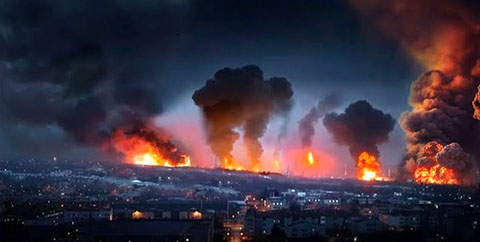
The strategic efficacy of Ukraine’s asymmetric campaign against Russian oil refining and transport infrastructure represents a critical pivot in the broader conflict dynamics, shifting the war from a purely territorial contest to a comprehensive attrition of Russia’s industrial and logistical capacity.
By targeting deep within Russian territory, Ukrainian long-range drone strikes have successfully degraded the operational readiness of the Russian military machine by constraining fuel availability, increasing logistical friction and imposing severe economic costs on the Kremlin’s war finance model. This approach exploits the fundamental principle that logistics frequently holds primacy over strategy, as the success or failure of sustainment at lower levels of war exerts a greater effect on overall military outcomes than high-level strategic maneuvering.
The systematic degradation of Russia’s energy infrastructure is not merely an economic sanction but a direct kinetic intervention into the supply chains that fuel the Russian war effort, thereby accelerating the erosion of Russia’s capacity to sustain prolonged high-intensity combat operations.
The intensification of assaults on Russian energy infrastructure, particularly since March 2024, has demonstrated a sophisticated evolution in Ukrainian strike capabilities. Ukraine has deployed a multitude of long-range drones to hit some of Russia’s largest refineries, leading to temporary halts in production at several key facilities. These attacks are designed with the primary objective of diminishing Russia’s military capacity by disrupting the flow of refined petroleum products essential for armored vehicles, aviation and logistics convoys.
The strategic logic behind these strikes is rooted in the vulnerability of centralized processing nodes within the fossil fuel supply chain. Refineries act as critical transformation nodes where crude oil is converted into usable fuels such as diesel and jet fuel; damaging these nodes creates bottlenecks that propagate throughout the entire distribution network.
The economic value of relieving such bottlenecks is immense, and conversely, the cost of creating them through kinetic strikes imposes a heavy burden on the adversary’s operational flexibility. By targeting these specific nodes, Ukraine effectively weaponizes the interdependence of Russia’s energy export economy and its domestic military consumption requirements.
The impact of these strikes extends beyond immediate physical damage to induce profound logistical and economic disruptions. The Russian transport system, characterized by its vast territory and reliance on specific infrastructure corridors, faces increased efficiency losses when key refining and distribution hubs are compromised. The destruction or temporary incapacitation of refineries forces Russia to rely on alternative, often less efficient, supply routes and storage facilities, thereby increasing the logistical footprint required to sustain frontline operations. This aligns with the concept that logistical constraints based on mass and volume must be carefully managed to meet thermodynamic energy requirements for military hardware. Any disruption in this flow directly translates to reduced operational tempo.
Furthermore, the sanctions imposed on Russia’s energy sector have already made public welfare losses due to accumulated imbalances in the fuel and energy sector more sensitive to the Russian economy, necessitating substantial subsidies for oil refining that divert resources from other military or social priorities.
The geopolitical and economic ramifications of these infrastructure attacks are further amplified by their effect on international markets and Russia’s fiscal health. The interaction between crude oil prices and exchange rates is central to global financial stability and volatility spillovers between WTI crude oil and the Russian ruble indicate the fragility of Russia’s macro-economic balances under pressure. [WTI (West Texas Intermediate) Crude Oil futures contracts are traded on the New York Mercantile Exchange (NYMEX)]
While European fuel-tax cuts initially increased Russia’s oil profits by approximately €8 million per day, the direct physical destruction of refining capacity counteracts this by reducing the volume of exportable and domestically usable products. The reduction of Russia’s energy exports and the spatial distribution of economic effects caused by sanctions and kinetic strikes have led to significant regional economic contractions, exacerbating internal pressures within the Russian Federation. This economic strain is compounded by the fact that raw oil, fertilizer, fuels and gas energy are the main pillars of the Russian economy, and damage to these sectors constitutes one of the primary sources of macroeconomic injury.
Moreover, the effectiveness of Ukrainian strikes is enhanced by the broader context of Russian military and cultural vulnerabilities. The Russian state exhibits peculiar cultural vulnerabilities, including an overcentralized structure and a culture of disregard for human life, which impede its ability to adapt quickly to decentralized, asymmetric threats like drone warfare.
The failure of the Russian war machine to protect its deep rear areas highlights serious compromises in its leadership and chain of command, as well as the exhaustion of its offensive capabilities. The inability to secure critical infrastructure against relatively low-cost unmanned aerial vehicles underscores the degradation of Russia’s air defense networks and the broader failure of its modernization programs to deliver promised superiority in key weapon systems. This operational failure is mirrored in the logistical domain, where the primacy of logistics over strategy becomes evident as supply chain disruptions hinder the execution of broader strategic objectives.
The maritime dimension of this logistical war also plays a crucial role, particularly in the Black Sea. Ukraine’s adaptive sea-denial approach, integrating land-based strike systems and uncrewed platforms, has constrained Russian freedom of action and disrupted maritime logistics. Attacks on infrastructure such as the Kerch Bridge and logistics hubs in occupied territories further isolate forward-deployed Russian forces, complicating the replenishment of ammunition and fuel.
The Ukrainian combination of deep-strike drone campaigns against refineries and maritime denial operations creates a multi-domain logistical squeeze that restricts Russia’s ability to project power and sustain offensive operations. This integrated approach demonstrates how data-linked kill chains and advanced algorithmic warfare enhance battlefield transparency and lethality, allowing Ukraine to precisely target high-value logistical hubs.
So, Ukraine’s active attacks on Russia’s oil refining and transport infrastructure are effectively bringing Russia closer to defeat by systematically eroding the material basis of its war effort. These strikes exploit the inherent vulnerabilities of centralized energy systems, impose severe economic costs and disrupt the logistical flows necessary for sustained military operations.
By targeting the nexus of energy production and distribution, Ukraine is not only damaging Russia’s immediate military capacity but also undermining the long-term economic stability required to sustain a protracted conflict. The cumulative effect of these actions, combined with broader strategic and cultural vulnerabilities within the Russian state, suggests that the degradation of logistical and industrial infrastructure is a decisive factor in shifting the balance of the war in Ukraine’s favor.
By Rafael Lagard
© Preems