
A complete history of football
No sport in human history has captured the collective imagination of the planet quite like association football – known simply as “football” across most of the globe and “soccer” in North America and Australia. With an estimated 3.5 to 4 billion fans spanning every inhabited continent, football is not merely a sport: it is a cultural lingua franca, a political instrument, a multi-hundred-billion-dollar industry, and for billions of people – an inseparable part of their identity.
The numbers are staggering. FIFA, the sport’s international governing body, currently counts 211 member associations – more than the United Nations. The 2022 FIFA World Cup final between Argentina and France drew a global television audience approaching 1.5 billion viewers, making it the most-watched single sporting event in human history. The English Premier League is broadcast in over 200 countries and territories. Lionel Messi’s transfer to Inter Miami CF in 2023 generated a social media frenzy that temporarily crashed the club’s ticketing website and app.
Yet the story of how a rough medieval folk game evolved into this planetary phenomenon is as dramatic, improbable and fascinating as any World Cup final. It is a story that spans millennia, crosses oceans, survives wars and intertwines with colonialism, industrialisation, democracy and globalisation.
Long before a leather ball rolled across an English village green, people across the ancient world were kicking, throwing and chasing spherical objects for sport and ritual. The earliest recorded football-like game is cuju (蹴鞠) (also romanised as ts’u-chü, meaning ‘kick ball’), which originated in China during the Han Dynasty (206 BCE – 220 CE). Historical records – including the military manual Zhan Guo Ce – describe soldiers training by kicking a feather-stuffed leather ball through a small opening in a bamboo or silk net fixed between two poles. The game was used as military fitness training and later became a popular entertainment at the imperial court.
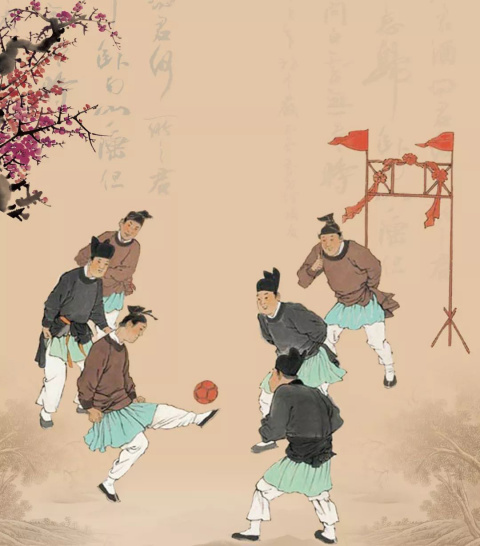
By the Tang Dynasty (618-907 CE), cuju had evolved considerably. Air-filled balls replaced the stuffed leather versions, and the goalposts were moved to the centre of the field. Remarkably, competitive leagues existed, professional players were employed by noble patrons, and women’s teams were recorded as playing in the imperial palace. Emperor Xuanzong of Tang was reportedly an avid cuju enthusiast. FIFA has formally acknowledged cuju as the earliest form of football.
. . . .
Ancient China’s gift to football
Cuju was played in China over 2,000 years ago. Air-inflated balls were used during the Tang Dynasty – a technology that Europe would not adopt until the 19th century. Professional players existed in China roughly 1,400 years before the Football League was founded in England in 1888.
. . . .
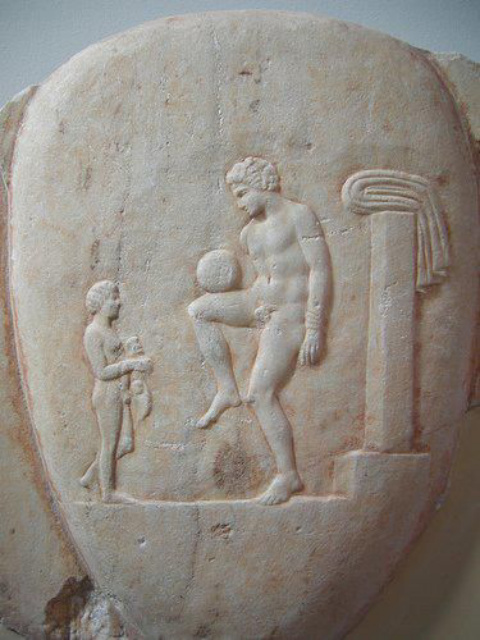
Ancient Greece had its own ball game called episkyros (Ancient Greek: ἐπίσκυρος – ‘upon the public’), documented as early as the 5th century BCE. Two teams of 12-14 players competed on a rectangular field divided by a white line, attempting to throw a ball over the opposing team’s boundary. Though primarily a throwing game, players could and did use their feet.
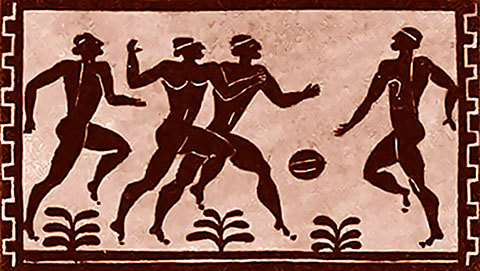
The Roman adaptation, harpastum, was more vigorous – a rough-and-tumble game played on a smaller field, emphasising ball retention over scoring. Roman legions carried harpastum throughout their empire, potentially spreading ball-game culture from Britain to North Africa.
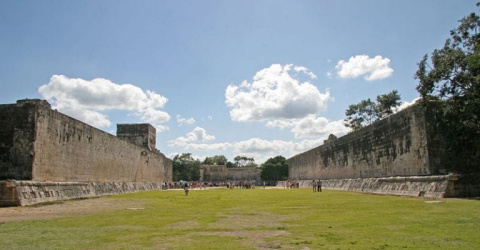
In MesoAmerica, the Olmec, Maya and Aztec civilisations developed the rubber ball game known as pok-a-tok or tlachtli, played in stone-walled courts. Heavy rubber balls (some weighing up to 3 kg) were struck through a stone ring using hips, knees and elbows. The game carried deep religious and cosmological significance; some versions are believed to have involved the sacrifice of losing (or winning, by some accounts) players. This tradition dates back at least 3,500 years – the oldest rubber ball yet found dates to approximately 1600 BCE.


In medieval England, France and Italy, various forms of ‘mob football’ were played during religious festivals and holidays, particularly Shrove Tuesday – the day before Lent began. These were spectacular, anarchic events involving entire towns. In the English game, two ‘teams’ (often neighbouring parishes or married men versus bachelors) attempted to transport an inflated pig’s bladder through the opposing town. There were almost no rules. Punching, kicking, wrestling and biting were commonplace. Goals could be miles apart. Games lasted all day and regularly resulted in broken bones, occasional fatalities and widespread property damage.
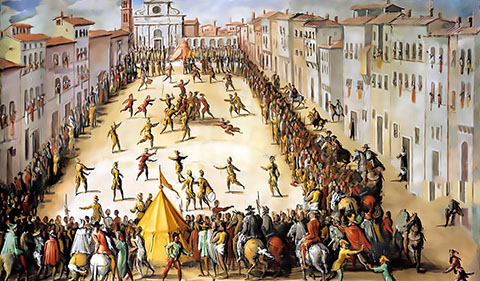
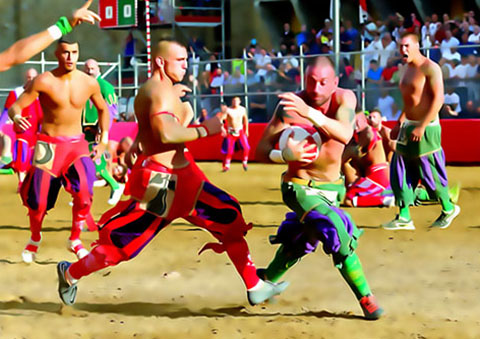
Florentine calcio storico, played in 16th-century Florence, was a more formalised version – 27 players per side competed in a large sand-filled square, with goals scored by throwing the ball over a raised border. Calcio storico was explicitly a game of the Florentine nobility; the 1580 Carnival game was notably played during a siege, with Florentine patricians defiantly taking to the pitch while the city was surrounded by Imperial troops. A revival of the game is still staged annually in Florence today.

. . . .
Royal bans on football
Football was so disruptive and dangerous that English monarchs repeatedly banned it. Edward II issued the first royal prohibition in 1314, calling it “a game in which there is great noise, a hustling over large balls, from which many evils might arise”. Similar bans were issued by Edward III (1349), Richard II (1389), Henry IV (1401), and Henry VIII – the last of whom was himself an enthusiastic player. Nevertheless, the bans were universally ignored.
. . . .
The transformation of chaotic folk football into a codified sport began in the English public school system during the first half of the 19th century. Elite schools such as Eton, Harrow, Rugby, Winchester and Charterhouse each developed their own local variants of football. When boys from different schools met at university – particularly at Cambridge – the incompatibility of these rules created an urgent need for standardisation.
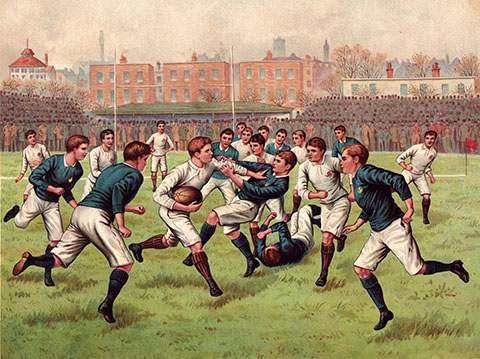
In 1848, students at Cambridge University hammered out the first set of unified rules in a meeting that lasted over seven hours in the Parker’s Piece park. The Cambridge Rules represented a pivotal moment: they distinguished the kicking game from the handling game and prohibited ‘hacking’ (kicking an opponent’s legs). These rules were refined over the following years but crucially split the football world into two camps: those who favoured the dribbling (kicking) game and those who preferred the handling game.
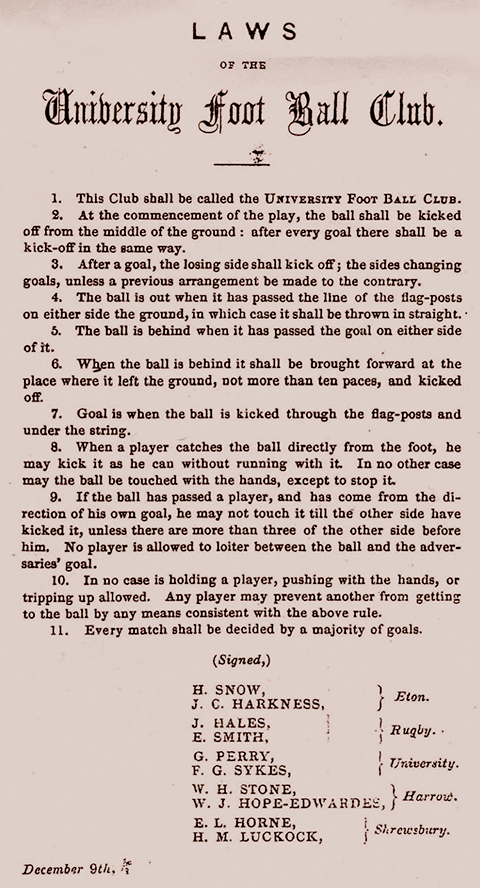
The decisive moment came on 26 October 1863 at the Freemason’s Tavern in London, where representatives of eleven clubs and schools gathered to found The Football Association – the world’s first football governing body. Over a series of meetings, the FA codified the Laws of the Game. When the Rugby faction insisted on retaining hacking and carrying the ball, the two codes formally parted ways. Association football and rugby football became separate sports on December 8, 1863 – a day that, in retrospect, changed sporting history forever.
The original 13 Laws of the Game established the fundamental character of association football: a kicking game, no handling of the ball except by the goalkeeper, goals scored by passing the ball under or through two posts. Many of these provisions would be immediately recognisable to a modern player, while others have since been modified or abolished entirely.
Crucially, the FA’s rules were publicly published and made freely available — a decision of enormous consequence. Any group of players anywhere in the world could read the rules and start playing. This openness, combined with Britain’s expanding global commercial and imperial reach, proved decisive in spreading the game internationally.
. . . .
FA Founded / 1863 / the world’s first national football association
Original Laws / 13 laws (vs. today’s 17 IFAB laws)
First FA Cup / 1872 / first national knockout competition in any sport
Football League Founded / 1888 / world’ first professional football league
First International Match / Scotland vs. England / November 30, 1872 (0-0 draw)
. . . .
Football’s global expansion in the late 19th and early 20th centuries was inextricably linked to Britain’s position as the world’s dominant industrial, commercial and imperial power. The game did not spread through formal colonial imposition (as cricket often did) but rather through informal contact: British sailors playing on dockside pitches, railway engineers laying tracks in South America and teaching locals the game during their rest days, textile workers in the cities of northern Spain and Portugal, and teachers at British-run schools and churches.
This informal missionary work was remarkably effective. The first football clubs in many countries were founded not by locals but by British expatriates, or by locals returning from education in Britain. In Brazil, the game is traditionally traced to Charles Miller, a Paulistano born to a British father and Brazilian mother, who returned from schooling in Southampton in 1894 carrying two footballs and a set of FA rules. In Argentina, the Buenos Aires Football Club was founded in 1867, making it the oldest club outside Britain.
. . . .
Football on the Dockside
Genoa Cricket and Football Club, Italy’s oldest football club, was founded in 1893 by British expatriates and sailors. The club was initially restricted to British nationals only. Meanwhile, FC Barcelona was founded in 1899 by Swiss footballer Joan Gamper after he placed an advertisement in a Catalan sports magazine seeking players – the club he co-founded would go on to become one of the wealthiest sporting organisations on Earth.
. . . .
Nowhere did football take root more deeply and productively than in South America, particularly in Brazil, Argentina and Uruguay. Within a generation of the game’s arrival, South American players had developed their own distinctive style: fluid, technical, creative and joyful in a manner that contrasted sharply with the more direct, physical British approach. This style, known in Brazil as futebol arte (art football) and globally as jogo bonito (the beautiful game), would come to define the sport’s aesthetic ideal.
Uruguay’s emergence on the world stage was breathtaking in its suddenness. In 1924, Uruguay sent a team to the Paris Olympics – the first time a South American nation had competed in Olympic football – and won the gold medal, stunning European audiences with their speed, technique and tactical intelligence. They repeated the feat in Amsterdam in 1928 and then, as hosts of the inaugural FIFA World Cup in 1930, won it on home soil, defeating Argentina 4-2 in the final in Montevideo before a crowd of approximately 68,000 people.
Argentina has produced more top-division professional footballers than any country in the world relative to its population, a statistical phenomenon that demographers and sociologists have studied extensively. The country’s football culture – its passion, its social centrality, its rivalries – is unique even within the football world. The Buenos Aires ‘superclasico’ between Boca Juniors and River Plate is routinely listed among the greatest derby matches in any sport.
European football developed along parallel but somewhat divergent lines. In Britain, professionalism was legalised by the FA in 1885 after years of disguised illegal payments, and the Football League – the world’s first professional league, comprising 12 clubs – was established in 1888 at a meeting proposed by Aston Villa director William McGregor. On the continent, national associations were slower to adopt professionalism. The French Football Federation did not permit paid players until 1932. The Italian Serie A turned professional in 1929.
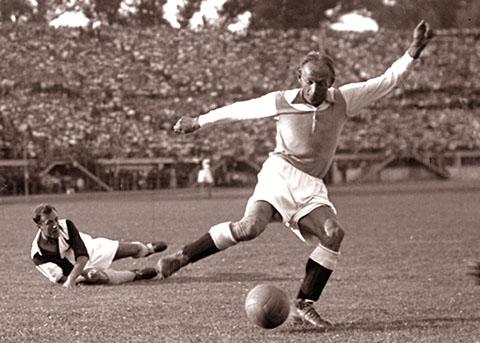
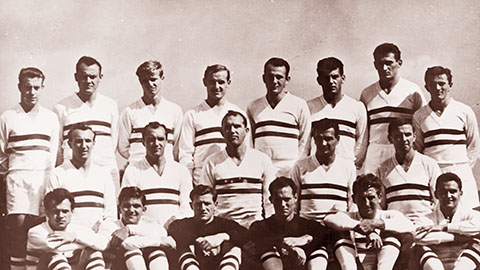
The Continent developed its own distinctive tactical traditions. The Austrian Wunderteam of the early 1930s, coached by Hugo Meisl and featuring the brilliant Matthias Sindelar (known as ‘the Mozart of Football’), played a refined passing game that drew enormous crowds across Central Europe. The Hungarian side of the early 1950s – the ‘Mighty Magyars’ featuring Ferenc Puskas, Sandor Kocsis and Nandor Hidegkuti – went 32 matches unbeaten between 1950 and 1954 and famously defeated England 6-3 at Wembley in 1953, the first time England had lost at home to a continental team – a result that shook British football to its foundations.
. . . .
The Mighty Magyars
Hungary’s 6-3 victory at Wembley in November 1953 is considered one of the most significant results in football history. The English press called it ‘the match of the century’. Captain Billy Wright of England later said: “We completely underestimated the advances that Hungary had made”. Hungary’s revolutionary deep-lying centre-forward tactics, pioneered by Nandor Hidegkuti, would influence the development of the false nine – a position used by Messi and other modern greats.
. . . .
As football spread beyond Britain’s shores in the late 19th century, the need for an international governing body became apparent. FIFA – the Fédération Internationale de Football Association – was founded on 21 May 1904 in Paris, initially by seven founding nations: France, Belgium, Denmark the Netherlands, Spain (represented by Madrid FC, a forerunner of Real Madrid), Sweden and Switzerland. Britain’s four associations initially declined to join, viewing the continental federation with suspicion, though they eventually affiliated with FIFA in 1906.
FIFA’s founding statutes were elegantly simple: respect each other’s regulations, acknowledge that international matches would be played under the Laws of the Game, and maintain the exclusivity of international competition. These principles remain at FIFA’s core, even as the organisation has expanded to 211 member associations and transformed into one of the world’s most powerful (and, periodically, most controversial) sporting bodies.
The FIFA World Cup, held every four years since 1930 (with interruptions for World War II in 1942 and 1946), has grown into the most-watched and most-attended sporting event in history. Each edition is a four-year story in itself, combining sporting drama with geopolitical subtext, individual genius, and collective heartbreak on a global scale.
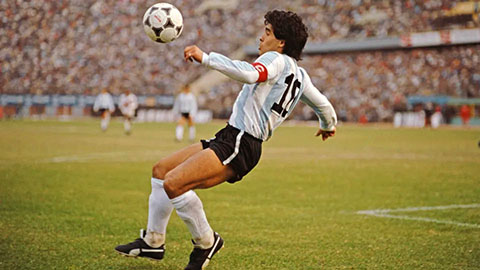
The tournament’s history is studded with defining moments. The ‘Hand of God’ goal by Argentina’s Diego Maradona against England in 1986 – a goal scored with his fist that the referee failed to disallow, followed four minutes later by what is statistically rated the greatest goal ever scored – encapsulates the tournament’s mixture of beauty and controversy.
Germany’s 7-1 demolition of host nation Brazil in the 2014 semi-final (known in Brazil simply as “the Mineirazo”) reduced a nation that considers itself the spiritual home of football to collective grief. And the 2022 final between Argentina and France – played out in Al Khor, Qatar – produced one of the greatest individual performances in football history, as Kylian Mbappe scored a hat-trick in normal time only to see Messi’s Argentina prevail on penalties in what many journalists called “the greatest World Cup final ever played”.
. . . .
Most World Cup titles / Brazil – 5 / 1958, 1962, 1970, 1994, 2002
Most goals in a single WC / Just Fontaine / France / 1958 / 13 goals
Largest ever WC audience / ~1.5 billion viewers / 2022 final / Argentina vs France
First World Cup / 1930 / Hosted by Uruguay; 13 nations participated
2022 World Cup (Qatar) 32 teams / $7.5 billion in FIFA revenue generated
2026 World Cup / USA, Canada and Mexico; expanded to 48 teams
. . . .
While FIFA governs global football, the continent-level confederations – and particularly UEFA in Europe – have wielded enormous influence over the modern game’s development. The UEFA Champions League, launched in its current format in 1992 (evolving from the European Cup, founded in 1955), has become the premier club competition in world football and one of the most lucrative sporting competitions in the world.
The competition’s iconic anthem – George Frideric Handel’s “Zadok the Priest”, rearranged with the Latin hymn “Hail, champion” – plays at a competition that generates in excess of EUR 3.5 billion annually. Real Madrid, with 15 European Cup/Champions League titles, has dominated the competition across its history; their victories with Alfredo Di Stefano in the 1950s and with Cristiano Ronaldo and Luca Modric in the 2010s bracket a story of sustained excellence remarkable in any sport.
Football’s tactical development is one of the great intellectual stories in sport. The early game in the 1880s and 1890s was played in an attacking 2-3-5 pyramid formation – two defenders, three midfielders and five forwards – reflecting an assumption that goals, not defence, were the point. Goalkeeper Herbert Kingsley of England became the first goalkeeper to wear a different coloured shirt (1909), illustrating how the position’s importance was still being discovered.
The introduction of the offside law change in 1925 – reducing the number of defenders required between an attacker and the goal from three to two – triggered an immediate tactical response. Arsenal manager Herbert Chapman developed the ‘WM’ formation (3-2-2-3), pulling one of the five forwards back into midfield to create a more defensively solid structure. Chapman’s Arsenal won five league titles in the 1930s and his tactical insight transformed football coaching as a discipline.
The 1950s and 1960s saw further radical evolution. Brazil’s 4-2-4, debuted at the 1958 World Cup with the 17-year-old Pele as its apex, revolutionised attacking football. Italy’s catenaccio (‘door-bolt’) system – featuring a sweeper (libero) positioned behind the conventional defence – was perfected by Helenio Herrera’s Inter Milan of the early 1960s and provided the tactical template for defensive excellence. Total Football, developed by Ajax Amsterdam and the Dutch national team under Rinus Michels in the early 1970s – whereby any player could take any position at any moment – introduced concepts of pressing, space and positional interchange that remain central to elite football today.
The most recent tactical revolution – Barcelona’s tiki-taka under Pep Guardiola (2008-2012), characterised by rapid short-passing possession football, high pressing to win the ball back instantly, and the ‘false nine’ position – produced arguably the most complete club side ever assembled. That team won 14 of a possible 19 trophies in four seasons and changed how coaches at every level of the game thought about possession, space and pressure.
. . . .
The Gegenpressing revolution
Jurgen Klopp’s development of ‘gegenpressing’ (counter-pressing) at Borussia Dortmund and later Liverpool represented a counter-revolution against tiki-taka possession play. Rather than keeping the ball patiently, gegenpressing aims to immediately win it back when possession is lost, exploiting the brief moment when opponents are disorganised. Klopp described it as ‘the best playmaker in the world’ – winning the ball in dangerous positions rather than patiently building from the back.
. . . .
Edson Arantes do Nascimento, universally known as Pele, remains the most symbolically important figure in football history. Born into poverty in Três Corações, Brazil, in 1940, Pele played his first professional match for Santos FC at the age of 15. At 17, he became the youngest player to score in a World Cup final when Brazil defeated Sweden 5-2 in 1958 – and wept openly on the shoulder of his teammate Djalma Santos at the final whistle, an image that appeared on front pages around the world.
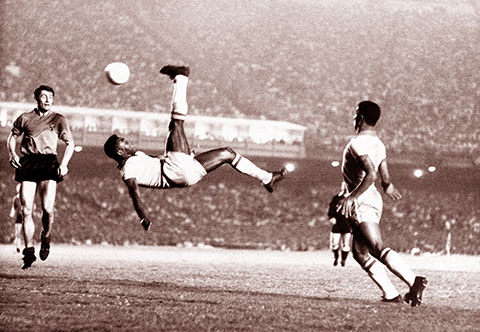
Pele won three World Cups (1958, 1962 and 1970) – the only player in history to achieve this feat. He scored an officially verified 757 goals in 831 competitive matches for Santos and Brazil, though including friendlies, his total approaches 1,281 in 1,366 matches. He scored his 1,000th goal (counting all matches) in 1969 – an event that temporarily halted a civil war in Nigeria, where opposing forces reportedly agreed a 48-hour ceasefire to watch footage of the milestone.
Diego Armando Maradona may be the most compelling figure football has produced – a player of supernatural individual genius wrapped in a life story of Shakespearean drama. Born in the Buenos Aires shantytown of Villa Fiorito in 1960, Maradona performed keepy-uppies on television at age 10 and signed his first professional contract at 15. His performance in the 1986 World Cup in Mexico – where he led Argentina from second-round elimination danger to the championship trophy, winning every player of the tournament award – is widely considered the greatest individual display in World Cup history.
The quarter-final against England, played five years after the Falklands War, produced two of the most famous goals ever scored: the ‘Hand of God’ (deliberately but illegally struck with his left hand past goalkeeper Peter Shilton, who still refuses to shake Maradona’s hand in retrospect) and the ‘Goal of the Century’ – a 66-metre, 10-second dribble past five English outfield players and the goalkeeper, voted the greatest goal in World Cup history by listeners of BBC Radio 5 Live.
The defining sporting argument of the 21st century’s first two decades is the question of whether Lionel Messi or Cristiano Ronaldo is the greatest footballer of all time. The debate is not merely a matter of preference but of philosophy: Messi’s genius is instinctive, spatial and almost untranslatable – an intelligence about space and movement that coaches struggle to explain. Ronaldo’s excellence is relentless, physical and quantifiable – a manufactured perfection driven by extraordinary athleticism and unsurpassed work ethic.
Messi has won eight Ballon d’Or awards (the most in history), six European Golden Shoes, and – following his team’s victory in the 2022 World Cup – has arguably become the consensus choice as the greatest player of all time. Ronaldo has won five Ballon d’Ors and holds the records for most goals in Champions League history (140) and most international goals by a male player (128 for Portugal as of mid-2024). Both men spent the majority of their careers in the Spanish La Liga – Messi at Barcelona, Ronaldo at Real Madrid – turning the el clasico fixture between those two clubs into the most-watched regular club match in the world.
For most of its history, football was emphatically not a big business. The first FA Cup final at the Kennington Oval in 1872 attracted a crowd of approximately 2,000 spectators who paid a shilling each (roughly equivalent to a few pounds today) for admission. The Football League’s founding clubs in 1888 paid their players wages from gate receipts; average attendances were a few thousand, and the typical footballer earned a wage comparable to a skilled factory worker.
The maximum wage – an FA rule limiting footballers’ earnings – remained in place in English football until 1961, when Professional Footballers’ Association chairman Jimmy Hill (later a famous television broadcaster) led a campaign to abolish it. The immediate post-abolition period saw wages rise modestly; the true transformation came later, driven by a force that none of the game’s Victorian founders could have anticipated: television.
The launch of the English Premier League in 1992 is the single most consequential commercial event in football history. The existing First Division’s top clubs broke away from the Football League specifically to negotiate their own television deal, signing a five-year contract with BSkyB for 304 million pounds – a figure that seemed extraordinary at the time and now seems quaint. Sky’s coverage, with its glossy production values, Monday Night Football slot and relentless marketing, transformed English football from a sport associated with crumbling terraces and crowd violence into a premium entertainment product.
Each successive rights cycle has dwarfed the previous one. The 2022-2025 domestic rights cycle was sold for approximately 5 billion pounds; international rights add several billion more. For the 2025-2028 cycle, total Premier League broadcast rights are valued at over 12 billion pounds. The 20 Premier League clubs collectively earned approximately 6.5 billion pounds in revenue in 2022-2023, with the bottom club receiving more in broadcast distributions than many successful continental champions.
. . . .
The Premier League’s financial dominance
In the 2022-2023 Deloitte Football Money League, 8 of the top 20 highest-earning clubs in world football were English Premier League clubs. The PL’s collective revenue dwarfs any other domestic league: the Bundesliga’s collective revenue is roughly 60% of the Premier League’s, while La Liga’s is approximately 55%.
. . . .
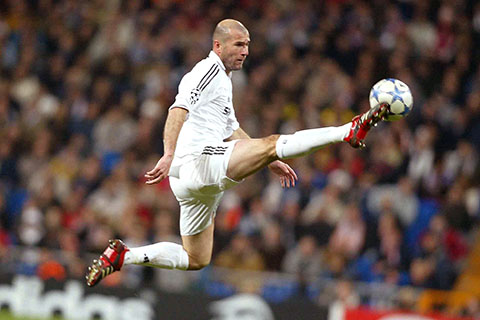
The transfer market – the mechanism by which players move between clubs in exchange for fees – has inflated spectacularly in the modern era. The first five-figure transfer was Sunderland’s purchase of Alf Common for 1,000 pounds in 1905 (causing national outrage at the time). The first million-pound transfer was Giuseppe Savoldi’s move to Napoli in 1975. By 2001, Zinedine Zidane moved from Juventus to Real Madrid for a then-record 77.5 million euros.
In 2017, the entire landscape changed when Paris Saint-Germain, backed by Qatar Investment Authority, Qatari sovereign wealth fund, activated the release clause of Neymar Jr.’s Barcelona contract, paying 222 million euros – more than doubling the previous transfer record at a stroke. PSG then loaned Kylian Mbappe from Monaco for 180 million euros and made the move permanent for an additional 145 million. These figures are underpinned by a complex ecosystem of agents, intermediaries, image rights deals and sponsorship packages.
. . . .
Most expensive transfer ever / Neymar Jr. / Barcelona to PSG / 2017 / €222 million
Most expensive British transfer / Jack Grealish / Villa to Man City / 2021 / £100 million
Annual global transfer spend / ~$6-7 billion per year (all leagues combined)
PL clubs’ transfer spend 2023 / Approx. £2.5 billion in the summer 2023 window alone
Biggest transfer of 2023 summer / Declan Rice / West Ham to Arsenal / £105 million
. . . .
Modern elite football clubs are not sports clubs in any traditional sense – they are diversified entertainment and media businesses. Real Madrid’s annual revenue exceeds 800 million euros; Manchester City, Barcelona and Manchester United all operate at comparable scale. Revenue streams include matchday income (tickets, hospitality, catering), broadcast distributions, commercial income (sponsorships, merchandise, licensing) and increasingly, digital and content revenues.
The shirt sponsorship market has evolved from humble beginnings – Kettering Town became the first British club to carry a commercial shirt sponsor in 1976, creating an FA controversy – to a multi-billion-dollar global industry. Manchester United’s front-of-shirt deal with TeamViewer was worth approximately 47 million pounds per season; their Adidas kit manufacturing deal is reported to be worth over 750 million pounds over ten years. The global market for football replica shirts alone exceeds 5 billion dollars annually.
The emergence of Gulf state and American private equity ownership has fundamentally altered the competitive landscape. Manchester City (owned by Abu Dhabi United Group since 2008), Paris Saint-Germain (Qatar Sports Investments since 2011) and Newcastle United (Saudi Public Investment Fund since 2021) have used sovereign wealth to transform the competitive balance of their respective competitions. Meanwhile, American private equity firms – including RedBird Capital, Clearlake Capital and various pension funds – have taken significant stakes in clubs from Chelsea to Bologna, driven by the belief that European football remains undermonetised relative to American sports franchises.
Women’s football has a longer history than most people realise – and a more shameful institutional story. Women played association football in Britain from at least the 1880s, and during World War I, factory-based women’s teams drew enormous crowds. Dick, Kerr Ladies FC of Preston played on Christmas Day 1920 in front of a crowd of 53,000 at Everton’s Goodison Park – a figure that remained the attendance record for a women’s football match in England for over a century.
In December 1921, the FA responded to this popularity by banning women from playing on Football League grounds, citing (without medical evidence) concerns that “the game of football is quite unsuitable for females and ought not to be encouraged.” This ban remained in place for 50 years until it was lifted in 1971. The damage done to the women’s game in England and those countries that followed suit was incalculable – an institutional suppression of talent and opportunity on a massive scale.
. . . .
The FA ban and its legacy
The FA’s 50-year ban on women playing at Football League grounds (1921-1971) is one of sport’s most consequential acts of institutional discrimination. England’s women’s national team, despite the talent available, could not compete seriously until the ban was lifted. By contrast, countries like Germany and the U.S., which supported women’s football throughout the mid-20th century, established competitive traditions that took England decades to approach.
. . . .
The revival and growth of the women’s game from the 1970s onwards has been one of football’s greatest success stories, accelerating dramatically in the 21st century. The Women’s World Cup, first held in 1991 in China (won by the USA), has become a major global event. The 2023 edition, jointly hosted by Australia and New Zealand, broke every previous attendance and viewership record, with over 1.7 million tickets sold, a global broadcast audience exceeding 2 billion for the tournament, and the final between Spain and England drawing peak viewership figures that surpassed many men’s international matches.
The Women’s Super League in England, the National Women’s Soccer League in the USA, the Division 1 Féminine in France, and the Frauen-Bundesliga in Germany are now professional competitions with growing television audiences and increasing prize money. The NWSL’s first private equity-backed expansion club, Bay FC, sold out its 18,000-seat stadium for its inaugural 2024 home match. Arsenal Women drew 60,000 fans to the Emirates Stadium in 2023 – a record for a women’s club match in England.
Few phenomena in modern culture are as powerful as a football club’s role in shaping collective identity. FC Barcelona’s identity is inseparable from Catalan nationalism – the club’s motto ‘Mes que un club’ (‘More than a club’) explicitly acknowledges its political and cultural significance. Celtic and Rangers in Glasgow have long embodied Catholic Irish and Protestant Ulster identities respectively; their fixture (the ‘Old Firm’) has periodically been a flashpoint for genuine sectarian tension. Galatasaray’s slogan ‘Welcome to Hell’ – directed at visiting English clubs in European competition – captured the intensity of Turkish football culture for a global audience.
In Brazil, football clubs map onto social class, race and geography in complex ways. Fluminense and Botafogo are historically associated with Rio’s white upper-middle class; Flamengo and Vasco with working-class and Black Brazilian identity; Atletico Mineiro and Cruzeiro with the industrial city of Belo Horizonte. Understanding Brazilian society requires understanding Brazilian club football.
Football has inspired a remarkable body of artistic work across media. Nick Hornby’s 1992 memoir “Fever Pitch” – a confessional account of his obsessive support for Arsenal that mapped a fan’s emotional geography with literary seriousness – permanently changed how football was written about and helped legitimise football as a cultural subject worthy of serious attention. Eduardo Galeano’s “Football in Sun and Shadow” (1995) is widely considered the most poetic account of the game’s global story.
In cinema, films from “Escape to Victory” (1981, featuring Pele and Bobby Moore) to “Bend it Like Beckham” (2002) have used football as a vehicle for exploring broader social topics. Documentaries including “Senna” (2010) and “All or Nothing” (Amazon’s access-all-areas series on Arsenal, Manchester City and other clubs) have driven significant mainstream audiences to the sport. YouTube compilations of individual player highlights have introduced generations of fans in emerging markets to the sport’s greatest players.
Football’s extraordinary commercial growth has made its governing bodies targets for corruption. FIFA’s institutional problems came to a spectacular head on 27 May 2015, when Swiss authorities arrested seven senior FIFA officials at the Baur au Lac hotel in Zurich at the request of the United States Department of Justice, which unsealed a 47-count indictment alleging widespread bribery, fraud and money laundering related to the award of television rights and the hosting rights for World Cups. The investigation ultimately led to criminal convictions and guilty pleas from dozens of football officials worldwide. FIFA president Sepp Blatter, who had served since 1998, resigned within days.
The crisis prompted significant governance reforms under new president Gianni Infantino, including term limits, financial disclosure requirements and an independent ethics committee. However, controversies have continued: the award of the 2022 World Cup to Qatar, later found to have involved significant bribery, raised profound questions about governance, labour rights (migrant worker deaths during stadium construction drew international criticism), and whether hosting rights decisions are ever truly merit-based.
Racism has been an ugly constant in football’s history and remains a serious problem. Black players in English football were subjected to widespread monkey chanting from the 1970s through the 1990s; Viv Anderson became the first Black player to represent England at senior level only in 1978, despite the demographic reality of English cities. Italy’s Serie A has seen numerous racist incidents involving Black players in the 21st century. Online racist abuse directed at players following major matches – particularly penalty shoot-out misses – has become a serious social media problem, with Marcus Rashford, Bukayo Saka and Jadon Sancho subjected to widespread racist abuse following England’ Euro 2020 final defeat.
Campaigns including ‘Kick It Out’ in England, UEFA’s ‘No to Racism’ programme, and players taking the knee before matches (a gesture adopted widely during the Black Lives Matter movement) have raised awareness. However, enforcement remains inconsistent, and the tension between freedom of speech and protection from racial harassment is yet to be resolved across all jurisdictions in which football is played.
Football has been slower than many sports to embrace technology in officiating, but the Video Assistant Referee (VAR) system – introduced globally in the late 2010s – has transformed the game’s relationship with technology. VAR uses video footage and dedicated officials to review potential goals, penalty decisions, red card offences and cases of mistaken identity. Its implementation has been controversial: while it has corrected clear and obvious errors, it has also slowed the game, reduced spontaneous goal celebrations and produced marginal offside decisions (using millimetre-precision lines on broadcast footage) that have dismayed fans and players alike.
Beneath the officiating surface, data analytics has transformed elite football at every level. GPS vests track players’ distances covered, sprint speeds, accelerations and decelerations in real time. Heart rate and blood oxygen data inform training load management. ‘Expected goals’ (xG) – a statistical model that rates the probability of a shot resulting in a goal based on historical data – is now routinely cited in broadcast commentary. Companies including Opta, StatsBomb and Wyscout have built large businesses providing data to clubs, broadcasters and fantasy football operators.
. . . .
Football in numbers: The data revolution
During a Premier League match, top clubs generate over 3 million data points per 90 minutes. Each player’s GPS vest records their position 10 times per second. Liverpool FC’s data team, which worked closely with Jurgen Klopp’s coaching staff, has been credited with identifying Mohamed Salah, Sadio Mane, Naby Keita and Alisson Becker – transformative signings identified through data analysis when other clubs overlooked them.
. . . .
For most of the 20th century, football struggled to establish itself in the United States, where American football, baseball, basketball and ice hockey had entrenched themselves as the ‘big four’ sports. The North American Soccer League (1968-1984) made a bold attempt to establish the game, bringing Pele, Franz Beckenbauer and Johan Cruyff to American soil as marquee attractions but collapsed under financial pressure.
The awarding of the 1994 World Cup to the USA – with the condition that a professional league be established – led to the launch of Major League Soccer in 1996. MLS has grown steadily, expanding from 10 to 29 clubs by 2023 (with more planned), developing stadiums, youth academies and television audiences. The arrival of Lionel Messi at Inter Miami CF in July 2023 was a cultural watershed: his debut in the Leagues Cup drew the competition’s highest-ever ratings, Apple TV (which holds the MLS broadcast rights) reported a surge in subscribers, and Inter Miami tickets rose to among the most expensive in American professional sports.
The 2026 World Cup, to be jointly hosted by the USA, Canada and Mexico, is projected to be the largest and most commercially successful World Cup in history, with FIFA estimating revenues exceeding 11 billion dollars. The tournament will be the first to feature 48 teams (expanded from 32) and will be played in 16 cities across three countries, introducing the game to American audiences on an unprecedented scale.
As the world’s most popular sport, football faces both particular vulnerabilities and particular responsibilities regarding the climate crisis. Elite football’s carbon footprint is substantial: air travel for club and international matches, energy consumption in stadiums, supply chains for equipment and merchandise, and the travel of millions of fans contribute significantly. A 2021 study estimated that the English Premier League alone generates approximately 765,000 tonnes of CO2 per season.
Increasingly, clubs, federations and commercial partners are committing to carbon neutrality targets. Forest Green Rovers, a League One club in England, has been carbon neutral since 2017 – the first professional football club in the world to achieve this – using a solar-powered stadium and serving entirely plant-based food. UEFA’s sustainability strategy commits the organisation to net zero emissions by 2040. The debate about flying versus rail travel for short European fixtures is increasingly mainstream in club boardrooms.
From the anarchic Shrove Tuesday mob games of medieval English villages to the 80,000-seat cathedrals of modern football; from Charles Miller stepping off a ship in Santos with two footballs in 1894 to Lionel Messi’s Instagram account with half a billion followers – football’s journey is one of the most extraordinary stories in human cultural history.
The game persists and flourishes because it answers something fundamental in human nature: the desire for communal experience, for narrative drama, for the tension between individual brilliance and collective effort, and for the rare, luminous moments when beauty and competition coincide. A curling free-kick from a left foot, a perfectly timed counter-press followed by a sweeping team goal, a goalkeeper’s save that seems to suspend the laws of physics – these moments transcend language, cross cultural boundaries and connect billions of people who may share nothing else.
Football is also, indisputably, a business – and in many respects a flawed and sometimes corrupt one. The vast inequalities between super-clubs and lower-league clubs, the treatment of migrant workers during the Qatar World Cup construction, the racism that players still face, the environmental costs of a global sport – these are real and serious problems that the game has not yet resolved.
But football endures. It is played on volcanic rock in Cape Verde, in the high altitude of the Bolivian altiplano, on favela pitches in Rio and on the streets of every city on Earth. A ball, some space and a group of players – that is all it has ever needed. And that, in the end, is why it conquered the world.
By Linus Dery, London
© Preems