
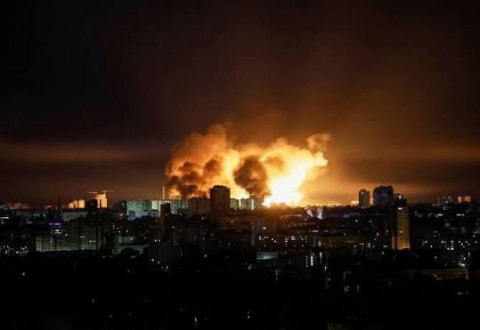
In the early hours of Sunday, May 24, 2026, Russia launched one of the largest combined aerial assaults of its four-year war against Ukraine. The attack involved 90 missiles of various types – including 36 ballistic missiles – and 600 Shahed-type strike drones, targeting Ukraine’s capital Kyiv and surrounding communities with unprecedented ferocity. An Oreshnik intermediate-range ballistic missile struck Bila Tserkva, a city in Kyiv Region, marking only the third operational use of this weapon system in the entire war. At least four Ukrainian civilians were killed and 83 injured across the country.
. . . .
Key facts of the May 24, 2026 attack
600 Shahed-type drones launched; 549 destroyed or jammed (91.5% interception rate)
90 missiles launched, including 36 ballistic missiles; 55 shot down, 19 failed to reach targets
Oreshnik RS-26 ballistic missile fired from Kapustin Yar; struck Bila Tserkva – third operational use in the war
4 civilians killed; 83 injured; 30 hospitalized in Kyiv alone
Damage reported in every district of Kyiv; communities of Fastiv, Bucha, Brovary, Bila Tserkva, Vyshhorod, Boryspil also struck
Targets: water supply facility (3 missiles), market (burned), residential buildings, schools
. . . .
The sheer scale of the assault – by virtually any metric the largest air attack on Kyiv in recent memory – paradoxically illuminates the depth of Russia’s strategic failure rather than its strength. While Putin ordered the strike ostensibly as “retaliation” for a Ukrainian strike on a drone command unit in Russian-occupied Starobilsk, the underlying reality is far more damning for Moscow: on the ground, Russian forces suffered a net territorial loss in April 2026 for the first time since the Kursk incursion of August 2024, Ukraine has recorded its first meaningful territorial gains in nearly three years, and Russian monthly casualties have reached catastrophic levels of up to 35,000 soldiers. The bombardment of Kyiv’s apartment buildings and schools represents not the hammer blow of a winning power, but the desperate, indiscriminate rage of a military machine failing to prevail where it matters most – on the battlefield.
The attack began in the late evening hours of Saturday, May 23, and continued through the early morning of Sunday, May 24. Ukraine’s Air Force issued its first alert shortly before midnight, warning of a potential Oreshnik ballistic missile launch. First wave of massive explosions were around 1:00 a.m. of local time, followed by successive waves between 3:00 and 5:00 a.m. The assault extended beyond Kyiv: explosions were heard in the cities of Cherkasy, Kropyvnytsky and across Khmelnytsky Region. Earlier in the night, Russian strikes also struck Odesa and Kharkiv Region, injuring civilians there as well.
At approximately 1:00 a.m., the U.S. Embassy in Kyiv had issued a security alert warning of a “potentially significant air attack” likely to occur within a 24-hour window, reflecting the level of advance intelligence shared by Western partners. Zelensky himself had warned the previous evening that Russia was preparing a combined strike on Ukrainian territory, including Kyiv, involving various types of weaponry. The warning was specific enough to identify the Oreshnik as a likely weapon – confirming that the attack, despite its ferocity, came as no strategic or tactical surprise to Ukrainian and Western intelligence services.
The combined attack employed an extraordinary range of weapons simultaneously:
Oreshnik RS-26 “Rubezh” Intermediate-Range Ballistic Missile: Launched from the Kapustin Yar rocket complex in Russia, the Oreshnik struck Bila Tserkva in Kyiv Region. This marked the third operational use of the weapon in the entire war – the first having been in Dnipro in November 2024, and the second against Lviv Region on January 9, 2026. The Oreshnik is reportedly capable of traveling at more than ten times the speed of sound and carries up to six independent hypersonic warheads, making it currently impossible to intercept with existing Ukrainian air defense systems.
Ballistic missiles (total 36): comprising the most dangerous component of the missile salvo. Ballistic trajectories offer shorter windows for interception and greater accuracy against fixed targets. Not all ballistic missiles were intercepted; Zelensky specifically noted this as a significant failure point of the night’s air defense performance.
Cruise and air-launched missiles (total 54 remaining): launched from air, sea and ground platforms, complementing the ballistic salvo and designed to overwhelm Ukrainian air defense radar and interception capacity through saturation.
600 Shahed-type strike drones: Ukrainian air defenses destroyed or jammed 549 of the drones, an interception rate of approximately 91.5%. The remaining drones that breached defenses caused fires and structural damage across the capital and surrounding communities. 19 missiles failed to reach their designated targets. Nevertheless, the sheer volume of 600 drones launched represents one of the largest single-night drone barrages of the entire war.
The strike was geographically concentrated on the Kyiv Region with an intensity causing damage in every district of the capital. In the Kyiv Region, Russian projectiles struck the communities of Fastiv, Bucha, Brovary, Bila Tserkva, Vyshhorod and Boryspil – hitting residential buildings, private homes, garages, utility buildings and a warehouse.
The specific targets are especially revealing: a water supply facility struck by three missiles, a market burned down, dozens of residential buildings damaged and several ordinary schools hit. These are not military targets. Russia’s defense ministry issued a formulaic statement claiming “all designated targets were hit” and that the attack was a “response to Ukraine’s terrorist attacks on civilian facilities within Russian territory.” The target list, however, belies any credible military rationale.
At least four civilians were killed: two within the city of Kyiv, and two more in the Bucha and Obukhiv districts of Kyiv Region. 56 people wounded in Kyiv alone, of whom 30 required hospitalization. Across the entire country, at least 83 people were injured. In Kyiv, the attack struck a 24-story residential building, with debris falling near a school in the city center. Poland activated its military aviation and scrambled Polish and allied fighter jets to protect its airspace, though no violations were detected.
Russia justified the assault as retaliation for a Ukrainian strike on a “student dormitory” at the Starobilsk College of Lugansk Pedagogical University in Russian-occupied Starobilsk, which Moscow claimed killed 18 people and accused Ukraine of targeting civilians. Putin ordered his military to “prepare options for retaliation.” Ukraine’s military flatly rejected the framing, stating it had targeted a Russian Rubicon drone command unit stationed in the Starobilsk area and had not deliberately struck civilian infrastructure.
The strategic logic of the “retaliation” narrative collapses under even basic scrutiny. Russia’s response – 90 missiles and 600 drones obliterating apartment buildings, water infrastructure, schools and a market in Kyiv – is not proportional retaliation. It is mass collective punishment of a civilian population, carried out with the most powerful weapons in Russia’s conventional arsenal. The use of Oreshnik – a missile system Putin has publicly boasted about as a nuclear-capable weapon of unprecedented destructive force – against a city like Bila Tserkva is not a calibrated military response. It is theater: an attempt to project power and terror that Russia cannot achieve on the front line.
The timing of the May 24 assault cannot be separated from a watershed development on the ground that occurred just weeks earlier. Russian forces suffered a net loss of 116 square kilometers of territory in April 2026. This was the first net territorial loss for Russia since Ukraine’s Kursk Region incursion of August 2024, representing a fundamental reversal of the slow but steady grinding advance Moscow had sustained throughout 2025.
Russia’s ministry of defense had overstated its own territorial gains by up to 112% – a figure that reveals the Kremlin’s strategic communication as a mirror of the military failure it is designed to conceal. The gap between what Moscow claims and what independent battlefield mapping confirms has never been wider.
Beginning in early 2026, Ukraine launched meaningful counteroffensive operations in the southeastern Regions of Dnipropetrovsk and Zaporizhzhia – the most fluid parts of the front line – and broke through Russian defenses in Dnipropetrovsk Region, advancing more than six miles in some sectors. Ukrainian Commander-in-Chief Oleksandr Syrsky confirmed in early March 2026 that Ukraine had captured more territory in February than Russia had seized in the same period, representing Ukraine’s strongest relative territorial performance since the Kursk incursion of summer 2024.
In March 2026, Ukraine had liberated 460 square kilometers – approximately 10% of what it lost to Russia in 2025. Ukrainian officials stated that almost the entire territory of Dnipropetrovsk Region has been liberated. Directional shift is unambiguous: Russia’s grinding advance has not only slowed but reversed.
The primary driver of Russia’s battlefield stagnation is its unsustainable personnel attrition. In March 2026, Russia was losing up to 35,000 soldiers per month – a figure that, if accurate, equates to an entire army division destroyed every thirty days. Russia’s army has stopped growing. Losses equal the number of newly mobilized soldiers. Russia is close to a crisis.
This dynamic is damning: every month that Russian forces fail to convert their staggering manpower losses into territorial gain widens the gap between what the Kremlin claims and what independent mapping confirms. The combination of Ukrainian deep strikes against Russian logistics, rapidly expanding Ukrainian drone interdiction operations, and Ukraine’s growing domestic defense industry has fundamentally disrupted the offensive calculus Moscow built its strategy around. The strategy of brute mass – throw enough bodies at the contact line and eventually break through – is visibly failing.
Throughout 2025, Russian forces increasingly shifted toward infiltration tactics, sending small groups to penetrate Ukrainian-held “gray zones” rather than attempting to seize terrain outright. This shift reflects the exhaustion of Russia’s capacity for large-scale set-piece offensive operations. It is the tactical adaptation of an army that has lost the operational initiative – not the methodical pressure of a force confident in its path to victory.
The deployment of the Oreshnik against Bila Tserkva – a mid-sized city of some 200,000 people, approximately 80 kilometers south of Kyiv – deserves particular analytical attention. Putin has repeatedly used his public statements about the Oreshnik to issue barely concealed nuclear threats. He has boasted that the missile is “impossible to intercept” due to its hypersonic velocity, and described it as capable of carrying both nuclear and conventional warheads. The first two Oreshnik strikes – Dnipro in November 2024, and Lviv Region in January 2026 – were accompanied by extensive Kremlin commentary designed to intimidate Ukraine and its Western partners.
Yet after three operational uses across eighteen months, Oreshnik has failed to alter any fundamental strategic dynamic of the war. Ukraine continues to receive Western weapons, its partners have not been deterred from supplying air defense systems, and the front line has not collapsed. Oreshnik strikes have killed and injured civilians, created terror and generated international headlines – but they have not broken Ukrainian will or changed the battlefield arithmetic in Russia’s favor. What Oreshnik represents is not military superiority, but the weaponization of fear as a substitute for battlefield results.
Putin can no longer even pronounce the word “hurrah” properly – he mumbles – yet he still conquers residential buildings with his missiles. The image of Putin mumbling victory slogans while obliterating apartment blocks rather than military fortifications crystallizes the essential paradox of Russia’s current strategic position: enormous capacity for destruction, combined with profound inability to achieve the war’s stated objectives.
Russia’s mass aerial campaign against Ukrainian civilian infrastructure follows a coherent, if morally abhorrent, logic that predates this war. The theory – rooted in the discredited “strategic bombing” doctrines of the 20th century – holds that sufficiently intense attacks on civilian populations will eventually break public morale, force governments to sue for peace, or create internal political pressure that undermines the enemy’s will to fight. Russian military doctrine has incorporated this approach most visibly in Chechnya, Syria and now Ukraine.
The specific targeting of Kyiv – the capital, the symbolic heart of Ukrainian statehood, the seat of government – also carries a psychological and political dimension. By attacking residential buildings within sight of government offices, Russia signals to the Ukrainian leadership and population that nowhere is safe. The near-daily rhythm of drone and missile attacks that Moscow has maintained almost daily since the full-scale offensive began, is designed to grind down civilian resilience over time.
By May 2026 – more than four years into the full-scale invasion – the evidence that Russia’s terror campaign has failed in its primary strategic objectives is overwhelming. Ukrainian public support for continued resistance remains high. The government in Kyiv has not collapsed, sued for peace on Russian terms, or been destabilized by civilian casualties. Ukraine has instead built one of the most sophisticated drone industries in the world, dramatically expanded its own deep-strike capabilities, and launched counteroffensive operations that are now reclaiming territory.
Ukraine’s air defense performance on the night of May 24 underscores the structural limitations of Russia’s aerial campaign. Of 600 drones launched, 549 were destroyed or jammed – a 91.5% interception rate. Of 90 missiles, 55 were shot down and 19 failed to reach targets – meaning fewer than 20 missiles successfully struck their intended objectives. Russia expended enormous resources – in drones, missiles, fuel, crews and the irreplaceable Oreshnik – to kill four civilians and injure 83. By any cost-benefit analysis of military effectiveness, this is a catastrophic return on investment.
Western military assistance – including the Hawk surface-to-air missile systems that the U.S. approved as recently as weeks before this attack – continues to flow. As Ukraine’s interception rates improve and its defense industrial base expands, the marginal effectiveness of each Russian missile and drone declines. Russia is engaged in an attrition contest it is losing in the air just as surely as it is losing on the ground.
The activation of Polish military aviation – including Polish and allied NATO fighter jets – during the May 24 attack reflects both the geographic proximity of the assault and the institutional reflexes of an alliance acutely sensitized to Russian escalation. The Polish military confirmed that no airspace violations were detected, but the scramble itself represents the ongoing cost of Russia’s aerial campaign on NATO cohesion and operational readiness. Poland’s border with Ukraine is less than 200 kilometers from the westernmost targets struck.
Russia’s stated justification – framing the attack as punishment for Ukrainian “terrorist” activity – has found no traction in Western capitals. The same logic has been deployed to justify dozens of prior mass strikes, and Western governments have consistently rejected it, continuing weapons supplies, intelligence sharing and financial support for Ukraine. The U.S. Embassy’s specific pre-attack warning, clearly based on shared intelligence, demonstrates the depth of Western intelligence cooperation with Kyiv – a form of strategic partnership that Russia’s aerial campaign has consistently failed to disrupt or deter.
This attack was characteristic in its combination of factual documentation, moral clarity and strategic framing. The specific atrocities – water infrastructure, markets, schools were documented – and immediately called for international accountability. It is important that this does not remain without consequences for Russia.
The Russia’s move is highlighted the preceding context: Ukraine had liberated 590 square kilometers of territory in 2026 thus far, forcing Russia toward diplomacy. The framing is deliberate. Russia’s massive strikes on civilian infrastructure are not evidence of Russian strength but of Russian frustration at military reversal – the last instrument of an adversary that has exhausted its capacity to win in the field.
The May 24 strike represents an intensification of a pattern that has defined Russia’s aerial campaign since the full-scale invasion began in February 2022. The historical record of Russia’s large-scale attacks reveals a consistent dynamic: the largest assaults consistently correlate with periods of Russian frustration on the ground. In May 2025, a mass attack killed 12 people across Ukraine using 56 cruise missiles, 9 ballistic missiles, and 298 drones. In November 2025, Russia launched more than 450 drones and 45 missiles, killing 10 and damaging energy infrastructure across three regions. Each escalation was framed as retaliation; each failed to achieve the strategic objective of breaking Ukrainian resistance.
The May 24, 2026 attack surpasses all prior recorded attacks in the sheer volume of weapons deployed: 600 drones and 90 missiles represents a significant escalation over any prior single-night barrage. This escalation should be understood not as evidence of Russia’s growing capacity for victory, but as a signal of its diminishing returns on the battlefield – a feedback loop in which the failure to win on the ground drives an ever-more-extreme resort to civilian terror as a compensatory strategy.
It is also worth noting that Russia is now losing an estimated 95% of its Shahed-type drones to Ukrainian air defenses – an interception rate that renders the mass drone campaign economically destructive for Russia itself. Iran, the primary supplier of Shahed drones, faces its own constraints. Russia has invested heavily in domestic Shahed production, but the capacity to absorb interception rates of 90%+ while maintaining operational tempo is finite. The drone war is one Russia is gradually losing technologically, even as it escalates numerically.
The May 24, 2026 attack on Ukraine – 90 missiles, 600 drones and Oreshnik over Bila Tserkva, 4 civilians killed, 83 injured, schools and water infrastructure burning across Kyiv – is, at its core, an act of strategic desperation. It represents the logical endpoint of a military doctrine that has no answer to the question of how to actually defeat Ukraine on the battlefield.
Russia entered the full-scale invasion of February 2022 expecting to conquer Kyiv in days. More than four years later, it has failed to capture Kyiv, failed to break Ukrainian public morale, failed to sever Ukraine’s ties with the West, and – as of April 2026 – is actually losing territory. It loses up to 35,000 soldiers every month and cannot grow its army faster than Ukraine and its partners destroy it. Its territorial claims, inflated by up to 112% in official ministry of defense statements, are a fiction Moscow tells itself. On the one front line that matters – the actual contact line in eastern and southern Ukraine -– Russia’s advance has not only stalled but reversed.
Into this context, Russia launches 690 weapons of war against apartment buildings, schools, water pipes and a market. It deploys its most advanced ballistic missile – a system capable of carrying nuclear warheads – to terrorize a mid-sized Ukrainian city. It kills 4 people and injures 83, at a cost in weapons and resources that dwarfs the tactical value of any objective struck. Ukraine’s air defenses shoot down or jam 604 of 690 projectiles and keep fighting.
History offers many precedents for powers that, unable to win on the battlefield, resort to the bombardment of civilian populations. In every case, this strategy has failed to substitute for military effectiveness. The Blitz did not break Britain. Dresden did not save Nazi Germany. Grozny did not produce a compliant Chechnya in the long term. The pattern is consistent: terror bombing of civilians, divorced from battlefield success, does not win wars.
The May 24, 2026 strike on Ukraine is, therefore, best understood not as a demonstration of Russian power, but as a monument to Russian failure. Every missile and drone that falls on a Kyiv apartment building is a confession – that Russia cannot take that building by ground assault; that its army is too depleted, too demoralized, too outmaneuvered to hold territory against an increasingly effective Ukrainian military; that the Kremlin has no answer to the question it has been unable to answer for four years: how do you actually defeat Ukraine? The answer, for now, is: you don’t. You bomb the schools instead.
By Rafael Lagard
© Preems