
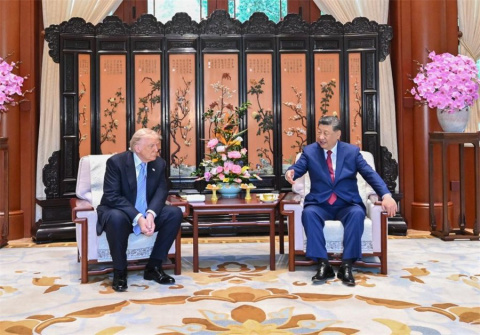
From May 13 to 15, 2026, U.S. President Donald Trump conducted a state visit to the People’s Republic of China, meeting with Chinese President Xi Jinping in Beijing. The trip — Trump’s second state visit to China and his first since 2017 — was the first presidential journey to Beijing in nearly nine years and stands as one of the most consequential diplomatic events of Trump’s second term.
Arriving amid the still-smoldering 2026 Iran War, a fragile global trade environment, and intense competition over technology and critical minerals, Trump’s Beijing visit carried implications far beyond bilateral relations, touching the geopolitics of the Middle East, the security of U.S. allies in Asia, and the future trajectory of the global order.
The summit produced modest but meaningful deliverables: a Chinese commitment to purchase 200 Boeing aircraft, pledges on fentanyl precursor controls, restored U.S. beef access to Chinese markets, and a framework for a bilateral trade board. Xi announced the two sides had agreed to establish a “constructive China-U.S. relationship of strategic stability,” and confirmed plans for a reciprocal visit to the United States in the fall.
Yet on the most pressing issues — Taiwan, the Iran War, artificial intelligence governance, and technology controls — significant divergences remained, and both sides issued post-summit statements that did not fully corroborate each other’s claimed achievements.
The U.S.–China relationship entering 2026 was defined by a turbulent 18 months. After Trump’s return to the White House in January 2025, his administration rapidly escalated economic pressure on Beijing, pushing tariffs on Chinese goods to unprecedented heights — at one point exceeding 140%.
China retaliated with its own tariffs and, crucially, weaponized its dominance over rare earth minerals and magnets, imposing export restrictions that sent shockwaves through global supply chains for semiconductors, electric vehicles, and defense systems. European automakers, Japanese electronics firms, and South Korean chipmakers all felt the disruption.
Despite the intensity of this confrontation, both governments retained channels for dialogue. The pivotal turning point came at the October 30, 2025 APEC summit in Busan, South Korea, where Trump and Xi held their first in-person meeting since 2019. After nearly two hours of talks, the leaders announced a one-year trade truce: the U.S. cut tariffs on Chinese goods from 57% to 47%, while China agreed to suspend rare earth export restrictions, resume large purchases of U.S. soybeans, and renew cooperation on fentanyl controls. Both leaders agreed that Trump would visit Beijing, and Xi would make a reciprocal visit to the United States.
When Trump’s Beijing visit was first announced following the Busan summit, its agenda was clear: consolidate the trade truce and expand economic cooperation. But by early 2026, geopolitics had dramatically reshaped the context. A U.S.-Israeli military campaign against Iran — launched amid escalating tensions over Tehran’s nuclear program — had ignited a war that sent global oil markets into turmoil and prompted the United States to impose a naval blockade of the Strait of Hormuz, the world’s most critical energy chokepoint.
This development placed China in an uncomfortable position. Beijing is Iran’s largest oil customer and a close strategic partner. China was also among the few nations capable of pressuring Iran toward a ceasefire. The Iran War thus became the shadow agenda dominating preparations for the Beijing summit, with Washington hoping Beijing would leverage its relationship with Tehran to secure a peace deal and reopen the Strait.
Defense Secretary Pete Hegseth announced in mid-April that China had given high-level assurances it would not supply weapons to Iran — a diplomatic signal that helped keep the summit on track.
The state visit had originally been planned for the first week of April but was postponed to May precisely because of the Iran conflict. Even as Trump landed in Beijing, the ceasefire with Iran was described as being on massive life support, and the war remained the single most urgent item on both leaders’ minds.
Trump’s arrival in Beijing carried profound historical symbolism. It was only the second time a sitting U.S. president had visited China in nearly a decade. The last time was Trump’s own 2017 visit, when Xi staged an elaborate ‘state visit-plus’ featuring a private dinner in the Forbidden City and the unveiling of $250 billion in business deals.
The 2026 summit was received with similar pageantry — skyscrapers lit up with Chinese characters reading “Beijing Welcome,” American and Chinese flags lined the highway from the airport, and Chinese Vice President Han Zheng led the greeting delegation at the tarmac, a sign of the visit’s diplomatic importance.
More than a dozen top American executives — including Apple CEO Tim Cook, Tesla CEO Elon Musk, and Nvidia CEO Jensen Huang — traveled as part of Trump’s delegation, signaling the centrality of technology and commerce to the summit’s ambitions. Their presence also underscored the extent to which U.S. corporate interests in China remained powerful, even after years of trade friction and calls for decoupling.
Trump entered Beijing with a set of overlapping objectives, some publicly stated and others more tacit. The most immediate priority was securing China’s cooperation on the Iran War — specifically, pressing Xi to use Beijing’s influence over Tehran to push for a ceasefire agreement and the reopening of the Strait of Hormuz. For Trump, ending the Iran conflict before it further destabilized global energy markets and damaged his domestic political standing was an urgent imperative.
Trade remained the second pillar of Washington’s agenda. After the 2025 trade war, Trump sought tangible economic deliverables he could present to American voters: purchase commitments for U.S. agricultural products, expanded market access for American firms, and concrete progress on fentanyl precursor controls. The Boeing deal — China agreeing to order aircraft from the American manufacturer — was exactly the kind of headline number Trump favored.
The Trump administration also wished to signal that his personal relationship with Xi could deliver results. The president had long argued that his unique rapport with the Chinese leader was a diplomatic asset that could resolve problems that conventional diplomacy could not. The Beijing summit was an opportunity to validate this claim and demonstrate that the Busan truce was holding.
China’s motivations were both strategic and economic. At the strategic level, Beijing sought to lock in the stability of the trade truce established at Busan and reduce the risk of further tariff escalations that could damage its economy. Despite China’s resilience — its GDP grew at a better-than-expected 5% in 2025 as exporters pivoted to non-U.S. markets and domestic technology investment accelerated — the Strait of Hormuz blockade was beginning to impose higher energy costs that threatened export markets worldwide.
Xi also wanted to frame the summit as evidence of China’s equal standing in the bilateral relationship. By hosting a U.S. president for the first time in nine years, Beijing could signal to its domestic audience and the broader international community that it had successfully withstood American economic pressure and emerged as a confident, indispensable global power.
The narrative of ‘the East rising and the West declining,’ which Xi had long promoted to the CCP, was given new credence by the fact that Trump appeared, in analysts’ assessment, to be coming to Beijing from a position of relative weakness.
On Taiwan, Beijing sought at minimum to prevent any rhetorical shift in U.S. policy that could embolden Taipei, and ideally to extract from Trump language suggesting support for peaceful unification or opposition to independence — a significant diplomatic prize.
China also wanted to resist tighter U.S. technology export controls, particularly on AI chips, which Xi’s advisers identified as the primary external constraint on China’s AI development. China is ready enough to be able to stand up to Trump on many key issues, including sanctions, technology controls, critical minerals, and Iran.
China held a structural advantage heading into the summit. Xi had demonstrated in 2025 that Beijing could absorb U.S. tariff pressure and retaliate effectively through the rare earth weapon. Meanwhile, Trump was managing an active war in the Middle East, a Supreme Court ruling in February 2026 that curtailed his authority to use emergency powers for tariffs, and domestic economic uncertainty. Some U.S. officials privately worried that Trump was walking into a summit where Xi held the cards.
Beijing’s eagerness to host the summit was, paradoxically, also read as a sign of its concerns. Despite outward confidence, China needed the trade truce to continue, was vulnerable to prolonged energy market disruptions, and was nervous about the possibility of an even more confrontational U.S. policy posture. Both leaders came to the table needing something from the other — which, analysts noted, created the conditions for at least limited progress.
Trump arrived at Beijing Capital International Airport on May 13, 2026, to a welcome ceremony designed to appeal to his well-documented appreciation for spectacle. Chinese Vice President Han Zheng greeted him at the foot of the aircraft steps. Children chanted in Mandarin, ‘Welcome, welcome, enthusiastically welcome.’ The motorcade drove through streets decorated with American and Chinese flags, and Beijing’s skyline was illuminated with celebratory Chinese characters.
The schedule across two days was intensive: a formal welcome ceremony at the Great Hall of the People, two bilateral sessions with Xi, a state banquet in the Golden Room of the Great Hall, a visit to the Temple of Heaven — only the second U.S. president to do so while in office after Gerald Ford in 1975 — and a tea ceremony at Zhongnanhai, the Chinese leadership compound. Trump praised the ‘magnificent welcome like no other’ and invoked Confucius, Benjamin Franklin, and Theodore Roosevelt in his remarks, framing U.S.–China relations in the language of deep historical friendship.
The formal talks covered an extraordinarily broad agenda. Trade and commerce dominated the first bilateral session, with both sides agreeing to establish a bilateral ‘Board of Trade’ to identify non-sensitive sectors for purchase commitments and limited tariff adjustments. Trump announced that China had agreed to order 200 Boeing aircraft — the first Chinese purchase from the U.S. aviation manufacturer since Trump’s 2017 visit, when 300 aircraft were ordered. However, the figure fell short of the 500 aircraft the industry had anticipated.
Agricultural trade was another area of apparent progress. Beijing restored U.S. beef imports, issuing new import licenses for hundreds of American suppliers — a gesture of goodwill timed to coincide with the summit. Discussions on fentanyl precursor chemicals produced a pledge to work toward ending the flow from China into the United States, though specific enforcement mechanisms were not publicly detailed.
The Iran War dominated the second bilateral session. Trump asked Xi to use China’s influence over Tehran to push for a lasting ceasefire and the reopening of the Strait of Hormuz. Xi’s response was careful: China positioned itself as a neutral party calling for dialogue and a diplomatic resolution, consistent with its longstanding foreign policy posture of non-interference. Trump later told reporters he and Xi had agreed that Iran should not have a nuclear weapon — a statement that, while significant, represented the lowest common denominator of agreement rather than a concrete action plan.
Perhaps the most diplomatically significant moment of the summit was what did not happen. The White House’s post-summit readouts made no mention of Taiwan, and Trump notably ignored reporters’ questions about the island during his time in Beijing. After returning to Washington, Trump warned Taiwan against seeking independence, saying, “I’m not looking to have somebody go independent,” and “we’re not looking to have somebody say, let’s go independent because the United States is backing us.”
Taiwan’s Foreign Minister Lin Chia-lung issued a statement emphasizing that U.S. policy toward the island had not changed and that Taipei was “maintaining good communication” with Washington. But Trump’s remarks can be interpreted as at least a rhetorical concession to Beijing — one that could embolden China to take more assertive steps in the Taiwan Strait. Any tacit bargain appearing to concede a U.S. sphere of influence over Taiwan in exchange for concessions elsewhere could have destabilizing consequences.
One of the most revealing aspects of the Trump-Xi summit was the divergence between the two sides’ official accounts of what was agreed. The White House readouts focused heavily on trade, while the Chinese Ministry of Foreign Affairs statements emphasized sovereignty, Taiwan, and opposition to the Iran War — without corroborating many of the specific commitments Trump touted publicly.
Xi’s announcement that the two sides had agreed to establish a ‘constructive China-U.S. relationship of strategic stability’ was framed by Beijing as a diplomatic framework — implying mutual restraint and respect for core interests — while U.S. officials offered no such characterization. China’s state media described the summit as ‘historical.’ Trump rated the meeting ‘fantastic.’
The summit’s trade outcomes were real but modest. The Boeing deal provided a tangible headline for Trump and a potential boost for American manufacturing employment. Chinese purchases of agricultural commodities — soybeans, beef, and other farm products — delivered relief to U.S. farmers who had been among the chief casualties of the 2025 trade war. The bilateral Board of Trade created a mechanism for structured economic dialogue that could, in time, produce more substantial agreements.
However, the absence of any comprehensive deal on tariffs, rare earths, or technology controls underscored the limits of what one summit could achieve. The Supreme Court’s February 2026 ruling restricting Trump’s use of emergency powers for tariffs had already diminished Washington’s leverage in economic negotiations. The administration was left relying on case-by-case commitments and personal diplomacy rather than systemic frameworks.
From a security standpoint, Trump’s China visit produced ambiguous results. On Iran, the most urgent issue, progress was limited to general statements of agreement that Tehran should not acquire nuclear weapons. No certain mechanism for China to pressure Iran was announced, and U.S. officials were frustrated that Beijing continued to hedge its position, wanting to appear as a neutral mediator while avoiding actions that would damage its relationship with Tehran.
The Taiwan dimension was more troubling for U.S. strategists. Trump’s failure to reaffirm arms sales commitments to Taiwan, his post-summit comments warning against Taiwanese independence, and the complete absence of Taiwan from White House readouts were interpreted in Taipei and among U.S. security analysts as signals that the island’s security guarantees were being informally negotiated away.
Trump’s non-commitment on Taiwan arms sales can be a win for China. The ongoing Iran War had diverted U.S. resources and attention away from Asia, potentially leaving South Korea, Japan, and Taiwan more vulnerable.
For Trump, the visit served several domestic political purposes. The pageantry and spectacle of being received in Beijing with elaborate ceremony played to his preference for grand diplomatic gestures and reinforced his self-image as the indispensable interlocutor in the world’s most consequential relationship.
Announcing the Boeing deal and agricultural commitments gave him material for a domestic narrative of deal-making success.
However, it is arguable that Trump had traded strategic assets for largely symbolic economic gains. The administration’s apparent softening on Taiwan and its failure to secure binding Chinese action on Iran amounted to diplomatic concessions with potentially serious long-term consequences for American security.
For Xi Jinping and the Chinese Communist Party, the summit was a significant strategic achievement. Hosting the U.S. president in Beijing for the first time since 2017 validated China’s international standing and its claim to be an equal partner in managing global affairs. The elaborate ceremonial welcome — the Temple of Heaven visit, the state banquet, the Zhongnanhai meeting — reinforced the narrative of China as a great civilization receiving the world’s most powerful nation on its own terms.
Xi’s success in weathering the 2025 trade war — emerging with the trade truce broadly intact, rare earth leverage preserved, and the U.S. president coming to Beijing — strengthened his domestic political position and lent credibility to his long-held argument that China had the resilience and strategic depth to resist Western economic pressure.
The economic outcomes of the summit were also favorable for China. The continuation of the trade truce provided stability for Chinese exporters and manufacturers. The implicit U.S. concession on Taiwan reduced one source of geopolitical risk for Beijing. And China’s positioning as a potential mediator in the Iran War — able to provide the U.S. with what it needed most (access to Tehran) — gave Beijing renewed leverage in future negotiations.
The agreement that Xi would visit the White House in September 2026, and that both leaders would attend APEC and G-20 meetings in the coming months, established a cadence of high-level engagement that Beijing views as institutionalizing its role as an indispensable global power.
Despite the triumphalist framing in Chinese state media, Beijing left the summit with significant unresolved vulnerabilities. U.S. technology export controls — particularly on advanced AI chips — remained in place, and Washington continued to accuse China of running ‘industrial-scale’ campaigns to steal American AI technology. China’s AI development remained constrained by its approximately eight-month lag behind U.S. capabilities, and Beijing’s semiconductor self-sufficiency drive was still years from delivering results.
The Iran War continued to pose economic risks for China through sustained energy market volatility. And Chinese companies seeking to expand into global markets faced an increasingly restrictive environment, with U.S. allies in Europe and Asia tightening their own technology and investment screening regimes.
Taiwan’s reaction to the summit was one of carefully managed anxiety. Taipei’s foreign minister emphasized that long-standing U.S. policy had not changed and that communication channels with Washington remained open. But behind this measured public response lay deep concern. The Taiwan Relations Act legally binds Washington to provide the island with the means to defend itself, but the act’s practical implementation is subject to presidential discretion — and Trump’s post-summit comments about not wanting Taiwan to go independent were seen as a concession to Beijing’s framing of the issue.
Any shift in U.S. posture — even rhetorical — could embolden Beijing to accelerate gray-zone operations against Taiwan: military exercises, economic pressure, cyberattacks, and efforts to erode the island’s international recognition. The absence of any reaffirmation of U.S. defense commitments from the summit left Taiwanese officials and security planners recalibrating their assumptions.
Japan, South Korea, and Australia all watched the Beijing summit with acute attention. For Tokyo and Seoul, the diversion of U.S. military and diplomatic resources to the Middle East — combined with any softening of U.S. commitments to Taiwan — raised questions about the reliability of Washington’s extended deterrence guarantees.
South Korea had already experienced the disruption of supply chains dependent on Chinese rare earths, and any arrangement that gave Beijing greater leverage over U.S. technology policy had direct implications for the Korean semiconductor industry.
Australia and other Indo-Pacific partners were similarly concerned about the summit’s potential signal that Washington was prioritizing bilateral deal-making with China over coordinated alliance management. The absence of any consultation with regional allies before or during the summit reinforced anxieties about Trump’s transactional approach to diplomacy.
European governments had a complex stake in the summit’s outcomes. China’s rare earth export restrictions had already disrupted European automakers, and any continuation of the trade truce and supply chain stabilization was welcome economic news. But Europe was also watching closely for any sign that Washington and Beijing were carving out bilateral arrangements that bypassed the rules-based multilateral trading order.
European leaders were also concerned about the Iran War’s impact on global energy markets and the extent to which a Trump-Xi deal on Iran might shape a post-war settlement without European input.
Summit’s consequences rippled through energy markets, technology supply chains, and geopolitical alignments from Brussels to Singapore.
Financial markets had been pricing in the possibility of the Beijing summit producing either a significant de-escalation or a new confrontation. The modest, mixed outcome — some deliverables, persistent divergences, no comprehensive deal — produced muted market reactions.
The confirmation of the trade truce and the Boeing and agricultural deals provided incremental stability. But investors and analysts noted the absence of structural resolution on tariffs, technology controls, and rare earths — issues that would continue to generate periodic volatility in global supply chains and commodity markets.
Summit’s most important contribution was not any specific agreement but the reestablishment of a structured dialogue mechanism — the bilateral Board of Trade — that could, if sustained, gradually reduce the risk of a further escalatory cycle between the world’s two largest economies.
One of the most politically significant issues in U.S.–China relations is the fentanyl crisis. The United States’ deadliest drug epidemic has been fueled in large part by synthetic opioids manufactured from chemical precursors shipped from China to Mexico, where cartels convert them into fentanyl before smuggling them into the United States. Trump had made fentanyl a central issue in his trade policy — the 2025 tariffs included specific levies on Chinese fentanyl-related products — and the Busan summit had already produced a Chinese commitment to crack down on precursor chemical flows.
The Beijing summit renewed these pledges, with both sides committing to work toward ending the flow of fentanyl precursors from China. However, Trump administration had complicated its own negotiating position by allowing the Biden-era Global Coalition to Address Synthetic Drug Threats to wither. The Stop Chinese Fentanyl Act, which would impose visa bans and sanctions on Chinese officials failing to cooperate on fentanyl, remained stalled in the Senate.
In March 2026, the U.S. began charging Chinese precursor smugglers with material support for terrorism, following the designation of Mexican cartels as foreign terrorist organizations — a significant legal escalation that may provide more enforcement leverage than diplomatic commitments alone.
Beneath the headline issues of trade, Taiwan, and Iran, a deeper and longer-term contest over artificial intelligence was a persistent subtext of the summit. The United States retains an approximately eight-month lead over China in it’s tech capabilities — a significant but narrowing margin. Beijing views U.S. export controls on advanced chips as the primary external constraint on its tech development, and Chinese tech companies and government officials have repeatedly lobbied for their removal.
The Council on Foreign Relations noted that Beijing approaches tech governance dialogues primarily as an opportunity to expand access to U.S. technology, closing the tech gap, rather than to address shared safety risks. The summit produced no breakthrough on tech — the bilateral Board of Trade was tasked with examining non-sensitive sectors for cooperation, deliberately excluding sensitive technology areas. But the summit established a framework for ongoing dialogue that could, in future meetings, begin to address tech governance issues more substantively.
The presence of Jensen Huang of Nvidia — whose advanced chips are at the center of U.S. export control debates — in Trump’s delegation was symbolically charged. It underscored the extent to which technology companies are caught between U.S. security imperatives and their commercial interests in China, the world’s second-largest tech market.
The Trump-Xi summit in Beijing achieved several real, if modest, goals. It reinforced the stability of the Busan trade truce and reduced the near-term risk of a fresh tariff escalation cycle. It produced tangible economic deliverables — the Boeing deal, agricultural purchases, restored beef trade — that have practical significance for American workers and farmers. It established a structured diplomatic mechanism in the bilateral Board of Trade that could serve as a foundation for future agreements. It confirmed a cadence of high-level engagement through Xi’s planned U.S. visit and both leaders’ attendance at upcoming multilateral forums.
Perhaps most importantly, it demonstrated that the two governments retain the capacity and political will for direct leader-level engagement, even under conditions of intense geopolitical stress — a war in the Middle East, contested technology competition, and unresolved disputes over Taiwan and human rights.
Against these achievements, the summit’s shortcomings were significant. On Iran — the most urgent issue — no concrete action plan was agreed; China continued to position itself as a neutral mediator while avoiding commitments that would genuinely pressure Tehran.
On Taiwan, Trump’s post-summit comments and the absence of Taiwan from White House readouts represent at minimum a rhetorical retreat that will embolden Beijing and unsettle Washington’s Indo-Pacific allies. On technology and AI, no progress was made on the underlying disputes over export controls, intellectual property, and chip access.
The divergent post-summit narratives from Washington and Beijing also highlight a structural problem: agreements between the two governments are often more ambiguous and fragile than they appear, subject to competing interpretations and incomplete implementation.
Zooming out from individual deliverables, the Beijing summit reveals something important about the current state of the U.S.–China relationship. The era of pure confrontation that defined much of 2025 has given way to something more complex: a managed competition in which both sides retain the ability to inflict significant harm on the other, but in which both also recognize the costs of escalation and maintain incentives for stabilization.
This is not cooperation, but it is not cold war either. It is a relationship defined by simultaneous competition and interdependence — in trade, technology, energy, and security — that neither side can afford to abandon but neither can safely trust. The Beijing summit extended the logic of the Busan truce: a temporary, transactional stabilization that serves immediate interests without resolving fundamental disputes.
Trump’s state visit to Beijing in May 2026 was a landmark diplomatic event — the first presidential visit to China in nearly nine years, conducted under the shadow of an active Middle East war, in the midst of an intense global competition for technological and economic supremacy. Its outcomes were real but circumscribed: a trade truce reinforced, modest economic deals struck, a framework for future dialogue established. But the fundamental tensions that define U.S.–China relations — over Taiwan’s future, access to critical technologies, fentanyl, human rights, and geopolitical influence — remained unresolved.
Xi Jinping emerged from the summit having largely achieved his objectives: hosting the U.S. president on China’s terms, securing the continuation of the trade truce, and preserving China’s leverage on rare earths and technology without making binding concessions.
Trump emerged with headlines he could use domestically but with less strategic clarity than he entered with. U.S. allies in the Indo-Pacific were left with renewed anxiety about the durability of American commitments.
And the broader international community — from European capitals to Southeast Asian trading nations — was reminded once again that the bilateral relationship between Washington and Beijing is the axis around which much of the global order revolves.
The Beijing summit of May 2026 was a stabilization rather than a resolution. It bought time. Whether that time will be used to construct a more durable framework for managed competition, or whether it merely postpones the next cycle of escalation, will depend on choices made in both capitals in the months and years ahead.
As Xi announced to the world and Trump confirmed in departing remarks: their next meeting will come in September, when Xi travels to Washington. The relationship — the most consequential, complex, and contested in the world — continues.
By Jason Woods, Washington D.C.
© Preems